If you are reading this with slightly shaky hands, feeling wrung out and scared and maybe a bit embarrassed that you ended up on Google trying to work out whether what just happened was a heart attack — take a breath. You are okay. You are probably more okay than you feel. The thing you just experienced is one of the most frightening and one of the most misunderstood events in human biology, and it has a specific name, a specific shape, and a specific ending. This article walks you through all of it.
We will cover: what actually happened in your body, why the symptoms felt like dying, whether you need to see a doctor, a breathing exercise you can use right now to settle your nervous system, and what to do in the next 48 hours so that one panic attack stays one panic attack rather than becoming something larger.
Sources: Kessler et al. (2006); DSM-5; NICE CG113; Clark et al. panic CBT outcomes.
What actually happened in your body
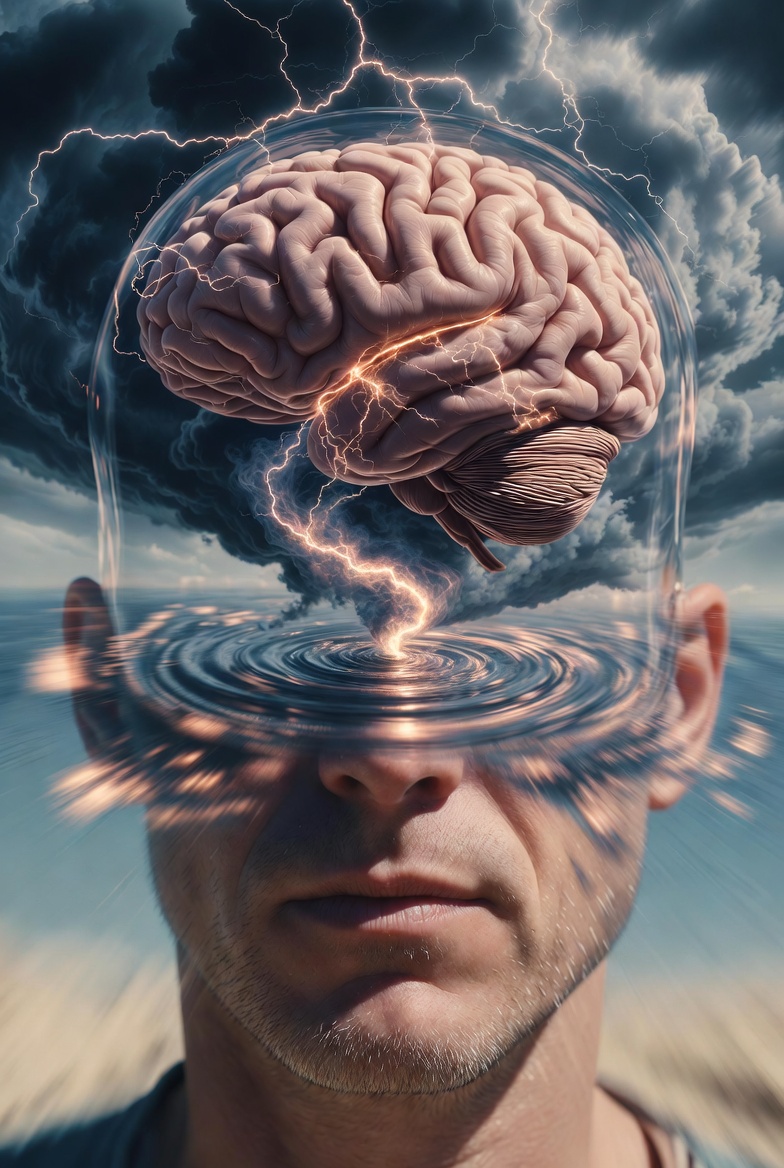
A panic attack is a massive, sudden activation of the body's fight-or-flight response — the same system that saves lives during a real emergency. In a panic attack, it fires without a real emergency present. Your brain's threat-detection centre (the amygdala) sends a signal to your adrenal glands, which flood your bloodstream with adrenaline. Within seconds, your heart rate rises sharply, your breathing gets faster and shallower, your blood redistributes to the large muscles, and your senses become hyper-alert.
Every one of the horrifying sensations you experienced has a precise and completely non-dangerous explanation. The pounding heart was your cardiovascular system preparing for sprint or combat. The tingling in your hands and face was caused by rapid breathing lowering your blood's carbon dioxide level — a phenomenon called respiratory alkalosis. The sense that the world looked unreal or that you were outside your body was derealisation, a common feature of high adrenaline states. The overwhelming certainty that something catastrophic was happening was not an insight. It was itself a symptom.
The system that produced all of this is magnificently designed and completely self-limiting. Your body cannot sustain this level of activation for long. Within 10 minutes of peak, the adrenaline is already clearing. Within 30 minutes, most of the acute effects are gone. You are never, at any point, in danger from the panic attack itself.
Do these match what you felt?
The DSM-5 lists thirteen recognised panic attack symptoms. Four or more, arriving rapidly and peaking within ten minutes, define a panic attack clinically. Below are the most commonly reported ones. If several of these match, you can be pretty confident about what you just experienced.
Why it felt like you were dying
The fear of dying during a panic attack is not a sign that something catastrophic is happening. It is a specific, predictable symptom of the adrenaline surge itself. Your brain is scanning for the reason its emergency alarm is going off, and because there is no actual tiger or burning building to assign the fear to, it turns inward and decides the emergency must be happening inside your own body. "Something is wrong with my heart. I can't breathe. I'm about to collapse."
This is where panic gets its self-amplifying character. The feared interpretation produces more adrenaline, which produces worse sensations, which seem to confirm the feared interpretation. This is called the catastrophic interpretation cycle, and it is the central engine of panic disorder. Understanding that the sensations are the entire story — not a signal of some hidden catastrophe — is the first step in dismantling it.
The shape of a panic attack, in time
Panic attacks follow a remarkably consistent arc. Knowing the shape in advance takes away much of the power of the experience, because you stop fearing that it will last forever.
The typical panic attack arc
Onset to recovery, across about 30 minutes
A useful frame to hold in your head during future episodes: the thing that is happening is already ending. By the time you are noticing the peak, the biology is already cleaning up after itself. You do not have to do anything to survive it. Your body is taking care of that part.
Something you can do right now
If you are still feeling shaky, or if you are reading this because the tail end of the attack has not fully cleared, here is a breathing exercise that genuinely works. It is called box breathing — four seconds in, hold for four, four out, hold for four. Used by the Royal Marines, paramedics, and in clinical panic protocols. It slows your breathing mechanically, which raises your blood CO2 back to normal, which switches your nervous system out of the fight-or-flight state.
Tap start, follow the circle. Let your breath match its movement. Two or three minutes is enough.
Box breathing pacer
Follow the circle. Breathe in as it grows. Hold. Breathe out as it shrinks. Hold.
If the pace feels too slow at first, that is normal when adrenaline is still clearing. Stay with it. Three minutes is enough to make a noticeable difference.
Do you need to go to A&E?
This is the question almost everyone asks after a first panic attack, and the honest answer depends on whether this is genuinely your first episode and whether your symptoms have fully resolved.
Call 999 or go to A&E now if: chest pain is severe, radiating to arm/jaw/back, is worse than anything you have felt before, or persists despite the attack having apparently ended; you are having difficulty breathing that is not improving; you collapsed or lost consciousness; you have cardiac risk factors or a personal/family history of heart disease. When in doubt with a first episode, get checked — this is not an overreaction.
For a standard first panic attack that has now settled — symptoms coming on rapidly, peaking within ten minutes, and clearing within about thirty — the right move is usually not A&E, but a GP appointment in the next few days. A GP can rule out other causes (thyroid, cardiac, respiratory), discuss what happened, and refer you to psychological support if it becomes needed.
After a first episode has been medically cleared, future episodes that follow the same pattern do not normally require emergency services. This matters because rushing to A&E for every panic attack is itself one of the main "safety behaviours" that maintain panic disorder over time. The first one is different — it is sensible to be cautious. Once assessed, subsequent attacks can usually be ridden out safely at home.
What actually helps (and what traps you)
"I need to avoid whatever triggered this. I need to check my pulse constantly. I can't risk it happening again."
Hypervigilance to body sensations. Avoiding places, activities, or situations where the attack occurred. Carrying emergency medications you don't use. Asking for frequent reassurance. Each of these shrinks your world and teaches your brain that the threat was real.
"That was horrible, and I now know what it was. I'm going to continue my life normally and let my nervous system settle."
Returning to normal activities without special precautions. Not monitoring your heart rate. Not avoiding the place it happened. Breathing exercises when anxiety rises. Accepting that another one might happen, and knowing you can survive it.
Will it happen again?
Possibly. A meaningful proportion of people who have one panic attack never have another. Another meaningful proportion have a handful across their lifetime. A smaller group develop panic disorder, where attacks become recurrent and fear of attacks starts shaping daily life. The single strongest predictor of which group you end up in is not the first attack itself. It is what you do in the weeks after.
The trap is not the biology. The trap is the cognitive and behavioural response — the catastrophic interpretation, the hypervigilance, the avoidance. People who move back into their lives relatively normally after a first attack, who treat it as a weird, frightening, but ultimately survivable event, tend to recover fully. People who start arranging their lives around avoiding the next one tend to spiral toward panic disorder. The second group is not weaker. They just had worse information. You now have better information.
The panic attack is not the problem. The fear of the panic attack is. Reduce the fear — through information, exposure, and gradual return to normal life — and you dismantle the cycle before it has a chance to form.
What to do in the next 48 hours
- Hydrate and eat. Adrenaline dumps deplete blood sugar and dehydrate you. Water, a proper meal, maybe some sugar. Your body needs fuel to reset.
- Rest, but don't isolate. Tell one person you trust — partner, parent, close friend. Not to be reassured, but so you don't carry this alone.
- Book a GP appointment. This week if possible. Explain what happened. Ask for a physical check and for a referral to NHS Talking Therapies, or self-refer yourself in most UK regions.
- Avoid the big three. Alcohol, caffeine, and cannabis all make panic more likely in the short term. Skip them for a week or two while your nervous system recalibrates.
- Don't start avoiding. If the attack happened on the Tube, take the Tube tomorrow. If it happened at work, go to work. Avoidance is the single most important factor that converts a one-off panic attack into panic disorder.
- Sleep. Panic attacks are strongly associated with sleep debt. Protect your sleep like it is medication for the next week.
- If it happens again, use the breathing exercise above. Let it pass. You will survive it, because you already did, once.
A last word, from someone who knows
If this was your first panic attack, you are going to remember the next few days for a long time. The fear will ease. The strangeness will fade. What you are carrying now will, in a few weeks, be a story you tell about a frightening thing that happened to you — and something you understand, in a way most people never will, about the ordinary miracle of a body trying to protect you too enthusiastically.
It was not a warning. It was not a punishment. It was not a sign you are broken. It was one event, and it is already behind you. You are, genuinely and entirely, okay.