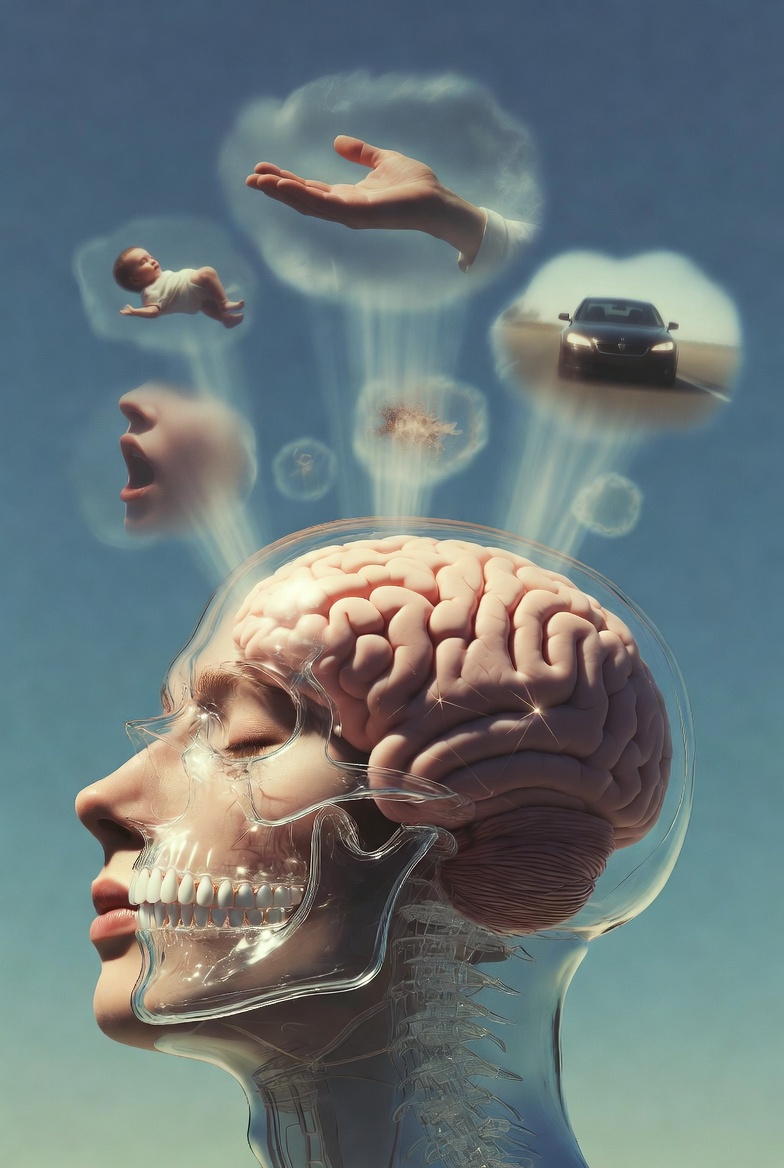
The first time it happens, you think something has catastrophically gone wrong with you. Your own reflection looks unfamiliar. The friends you are sitting with seem strangely two-dimensional, as though they are being played back on a screen. You are participating in your life but also watching it happen from slightly outside yourself, and the watching itself feels wrong. Nobody has ever described this to you. Nobody, surely, has ever felt this before.
They have. Roughly half of all people will experience at least one episode of derealisation or depersonalisation in their lifetime. During a panic attack, somewhere between half and three-quarters of people experience it. It is one of the most common and least discussed anxiety symptoms in existence, and the reason it is so rarely discussed is exactly why it terrifies people so much: they all assume they are the only one.

Sources: Hunter, Sierra & David (2004); Simeon et al. clinical studies; DSM-5.
What it actually is
Derealisation and depersonalisation are closely related experiences, and most people get both at once. The clinical distinction is simple. Derealisation is a disturbance in how the external world feels — the environment looks unreal, flat, dreamlike, two-dimensional, muffled, or as though you are seeing it through glass. Depersonalisation is a disturbance in how you feel — detached from your body, watching yourself from outside, emotionally numb, or unable to recognise your own thoughts or reflection as yours.
The critical thing, which nobody tells you, is that both are perceptual, not cognitive. The world is still there. You still know who you are. You still understand that what is happening is happening to your sense of reality rather than to reality itself. That preserved insight is what separates DP/DR from psychosis — and it is why it is so distressing, because you cannot talk yourself out of it. You know it is wrong. You just cannot make it stop by knowing.
What it feels like, in the words people use
If three or four of these match what you are experiencing, you now have a vocabulary for it. That matters. Being able to name an experience — "this is derealisation" rather than "something is horribly wrong" — is itself one of the most effective short-term interventions.
Why your brain does this
DP/DR is not a malfunction. It is a protective feature of the human nervous system that kicks in when incoming emotional or stress signals exceed a certain threshold. The brain effectively turns down the volume on emotional processing and on the integration between self-awareness and sensory experience. The result is a muted, detached, behind-glass quality to your experience of yourself and the world. It is the neurological equivalent of circuit breakers flipping to prevent damage.
In evolutionary terms, this was probably adaptive during overwhelming events — being attacked, witnessing trauma, facing something too much to feel fully in real time. The problem is that the same circuit also fires in response to modern stressors: a difficult week, a panic attack, cannabis, severe sleep deprivation, burnout. It was not designed with the steady hum of twenty-first-century anxiety in mind. But the mechanism is the same. Your brain is not failing. It is protecting you, slightly too enthusiastically.
The loop that keeps it going
Most DP/DR episodes would clear in hours if you simply left them alone. What extends them, often for days or weeks, is almost always the same pattern: the symptom arrives, you become terrified of it, and your terror is the exact cue that tells your nervous system to keep the protective mode engaged.
The DP/DR fear loop
Why the fear of feeling unreal keeps the unreal feeling going
The way out is not through forcing yourself to feel real. It is through reducing the fear you have about the experience and engaging with the world in ways that do not involve checking whether it feels right.
Something you can do right now
The classic clinical intervention for DP/DR is sensory grounding — deliberately engaging with physical reality in a way that bypasses the anxious monitoring loop. The most well-known version is 5-4-3-2-1: name five things you can see, four you can touch, three you can hear, two you can smell, one you can taste. It works because it gives your nervous system something concrete to anchor to, and because doing it is incompatible with spiralling.
You can do it here, silently, by tapping when you notice something. No typing needed.
5-4-3-2-1 grounding
Tap the button each time you notice something with that sense. Slow is fine. This is not a test.
Common triggers — some obvious, some not
If your DP/DR arrived seemingly from nowhere, it probably did not. The most common triggers in UK primary care, in rough order, are: acute anxiety or a panic attack, severe sleep deprivation (often several nights in a row), high-THC cannabis (particularly edibles or for first-time/infrequent users), excessive caffeine, dissociative drugs (ketamine, nitrous oxide), post-viral or post-COVID states, and periods of intense grief or acute trauma. Sometimes several are stacked. A hard week, bad sleep, a joint at a party, and a crowded tube the next day is a perfectly common recipe.
If cannabis was the trigger — which it often is, particularly for first-onset persistent DP/DR — you are in a large and under-acknowledged group. Stopping cannabis use completely is a necessary first step; the experience often improves significantly in the weeks after.
What helps, and what traps
"I need to figure out why this is happening. I need to test whether things still feel real."
Constant reality-checking, Googling symptoms, monitoring your own sense of self, avoiding places where it happened, reading forums that confirm the worst interpretation. Every check is a reinforcement. Every search is a message to your brain that something is still wrong.
"This is a recognised, protective response. I don't like it. I'm not going to fight it."
Accurate information (you already have it now). Sensory grounding in the present. Returning to ordinary activities even while the feeling is there. Sleep, food, water. Reducing the stressors that triggered it. For cannabis-induced cases, stopping cannabis entirely.
The paradox of DP/DR is the same as the paradox of every anxiety symptom. The more you demand that it go away, the longer it stays. The more you allow it to be present while you carry on with your life, the faster it leaves.
When to see someone
A single episode of DP/DR during a panic attack or a stressful week is not, by itself, a reason to see a doctor. If the experience is persistent — lasting most of most days for two weeks or more — it is worth speaking to your GP. Depersonalisation-Derealisation Disorder (DPDR) is a recognised clinical condition affecting roughly 1–2% of the population at some point in life. It is less rare than it is under-diagnosed, and it responds well to specialised CBT. In the UK, a GP can refer you, or you can self-refer to NHS Talking Therapies in most regions.
See a doctor more urgently if: the DP/DR is accompanied by memory loss, confusion, loss of consciousness, or neurological symptoms (weakness, visual disturbance, severe headache); if it followed a head injury; if you are experiencing thoughts of self-harm. These can rule out other causes and get you into care quickly. For mental health crisis support at any hour, Samaritans (116 123) and NHS 111 are both appropriate.
A last word
If you were scared when you started reading this, you should be less scared now. DP/DR is a real, well-documented, and entirely survivable experience. It is your nervous system protecting itself, slightly too well, in response to stress it did not have time to process any other way. It is not damage. It is not madness. It is not a sign that you are about to come apart.
You are reading these words. You are noticing the light in the room. Somewhere a kettle is on or a car is passing or a child is asking for something. The world is here. You are here. The feeling that you are not will pass, because these feelings always do, and you can help it on its way by getting on with your afternoon as best you can. Tea might be a good start.