Home Learn How it worksTechniquesPricing Case StudiesBlogContact LoginStart free →
Life Stages9 min read · April 2026

Perimenopause Anxiety: When Your Brain Suddenly Feels Like a Stranger's

Women who have never had anxiety in their lives are waking up at 3am with their hearts hammering. Calm, competent women in their forties are finding themselves irritable at small things, foggy, short of breath for no reason, crying in the car. It is not a coincidence, a phase of life-stress, or something you should just push through. It is hormonal, it is biological, and it is finally being properly understood. Here is what is actually happening to your brain chemistry, why GPs still miss it, and what genuinely helps.

Here is the pattern that might sound familiar. You are somewhere in your early-to-mid forties, possibly late thirties. Your periods are still mostly regular, though perhaps a little shorter, or heavier, or unpredictable. Your children are small, or growing, or just moved out — the usual complexities of midlife. And suddenly, without clear reason, the wiring inside your head has changed. You wake at 3am with your heart pounding. You are irritable in ways that do not match you. You forget words mid-sentence. You cry at advertisements. You are, for the first time in your life, anxious.

Your GP may say stress, or "it's that age," or offer an antidepressant. What most have not said, until very recently, is the word that actually describes what is happening: perimenopause. The hormonal transition that can begin up to a decade before your periods stop is one of the most under-diagnosed causes of new-onset anxiety in women. It is not in your head. It is in your endocrine system. And the good news is that it is now, in 2026, one of the better-understood conditions in midlife medicine — even if the awareness has not yet reached every GP's office.
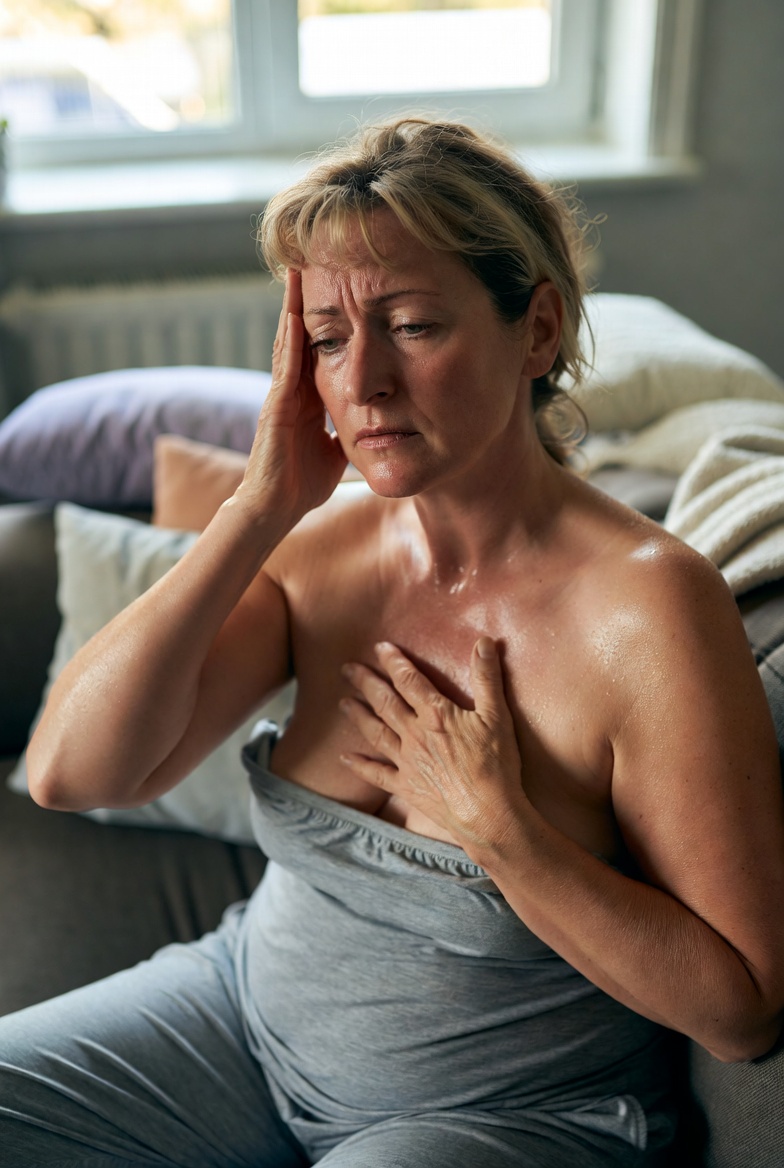
Perimenopause anxiety — when your brain feels like a stranger's — Stop The Loop blog
You are not going mad. Your brain chemistry is transitioning through one of the most significant hormonal shifts of your life.
40–60%Of perimenopausal women report significant psychological symptoms
4–10 yrsTypical duration of perimenopause before periods stop
~51UK average age of menopause itself — but the transition starts years earlier

Sources: Study of Women's Health Across the Nation (SWAN) longitudinal data; NICE NG23 menopause guidelines; British Menopause Society.

What perimenopause actually is

Perimenopause is the transitional period during which your ovaries begin their gradual slowdown toward ceasing ovulation altogether. It typically begins in your early to mid forties, though it can start as early as the mid thirties. It ends at menopause, which is defined technically as 12 consecutive months without a period — the UK average is around age 51, though individual variation is wide.

The part that matters clinically, and that is still widely misunderstood, is this: perimenopause is not a gentle decline of oestrogen. It is erratic, chaotic fluctuation. Oestrogen spikes and drops unpredictably from cycle to cycle, sometimes reaching levels higher than your younger self produced, other times dropping lower than your post-menopausal level will ever be. Progesterone, meanwhile, typically falls fairly steadily because ovulation becomes less reliable. The combination — volatile oestrogen plus dropping progesterone — is what produces the distinctive symptom constellation of perimenopause, including the psychological symptoms.

You can have all of this while still having regular periods. This is one of the most important and least-communicated facts about perimenopause: the hormonal storm starts years before cycle changes become obvious. Women who are told "you cannot be perimenopausal, your periods are regular" are being given medically incorrect information.

Why oestrogen changes produce anxiety

To understand why the hormonal changes produce anxiety so reliably, you have to understand what oestrogen and progesterone are actually doing in your brain — and it is much more than reproductive signalling. These hormones are, in effect, major neuromodulators. Your brain has oestrogen and progesterone receptors scattered across every structure that matters for mood regulation.

How hormonal changes become psychological symptoms

The chemistry of a neurotransmitter system suddenly without its usual stabiliser

Step 1
Oestrogen erratic
Levels spike and crash unpredictably cycle-to-cycle
Step 2
Serotonin wobbles
Oestrogen modulates serotonin — erratic in, erratic out
Step 3
Progesterone drops
Allopregnanolone (a natural anxiolytic) drops with it
Step 4
Cortisol rises
HPA axis becomes more sensitive — stress hits harder
Step 5
The symptoms
Anxiety, 3am waking, irritability, brain fog, new panic

Let me unpack the most important of those arrows. Progesterone, the hormone that typically falls first in perimenopause, has a metabolite called allopregnanolone. Allopregnanolone acts on GABA receptors in your brain in a way that is chemically similar to the mechanism of anti-anxiety medications like diazepam — it is, essentially, a naturally produced anxiolytic. When progesterone drops, allopregnanolone drops with it. Women who spent decades with a built-in calming chemical in their nervous system suddenly do not have it anymore. That alone can produce significant anxiety in someone who has never experienced it.

Oestrogen, meanwhile, regulates serotonin synthesis and receptor sensitivity. When oestrogen becomes erratic, so does serotonin — which means mood can swing unpredictably. On top of all this, oestrogen changes sensitise the HPA stress axis, meaning cortisol spikes last longer and hit harder than they used to. The same work deadline that produced calm focus at 35 can produce a full physiological stress response at 45. Nothing is wrong with your coping. Your stress chemistry has been retuned.

The signature patterns

Perimenopause anxiety has specific characteristics that help distinguish it from other forms. The more of these that fit, the more likely the hormonal frame is the right one.

Most-reported symptoms in perimenopausal women with anxiety

How often each shows up in the anxiety-prominent subgroup

3am waking
88%
Heart pounding
82%
New irritability
80%
Brain fog
76%
Night sweats
72%
Sudden tearfulness
68%
Sense of dread
64%
Word-finding loss
58%
Rage episodes
52%

Composite from perimenopause symptom surveys — illustrative, not a diagnostic instrument.

The 3am waking deserves a note because it is so characteristic and so misunderstood. Here is what happens: overnight your oestrogen level drops, which often triggers a small internal hot flash — one you may not consciously register as a hot flash. The hot flash produces a cortisol spike and a noradrenaline surge. You wake up into a full fight-or-flight state in the middle of the night, at the hour sleep is most vulnerable. Once awake with adrenaline flooding your system, the mind follows and starts generating reasons to be anxious. The racing heart is the cause of the 2am dread, not the consequence. This is diagnostic when it happens repeatedly in women in their forties.

The perimenopause map

Perimenopause is not a single state but a sequence of phases, and knowing where you are in the sequence helps enormously — both for making sense of symptoms and for knowing roughly what is coming. Here is the map, with the typical age ranges and the hormonal picture at each stage.

The perimenopause journey

Five phases, with indicative age ranges — individual variation is wide

Late 30s – early 40s Early perimenopause
Periods mostly regular. Subtle changes: slightly worse PMS, shorter or longer cycles, mild sleep disruption, occasional "off" days that feel inexplicable. Progesterone has begun to drop. Many women in this phase are told they are "too young" for perimenopause — this is medically incorrect.
SubtleOften missed
Early to mid 40s Mid perimenopause
Cycle changes become more noticeable. Anxiety often arrives here, frequently in women with no prior history. 3am waking starts. Night sweats begin, sometimes subtle. Mood swings. Brain fog. This is the phase where most women first notice something is meaningfully different.
Anxiety often startsOften mis-labelled stress
Mid to late 40s Late perimenopause
Periods become irregular — skipped months, then return. Hot flashes and night sweats become more prominent. Anxiety and insomnia typically peak in this window. Oestrogen fluctuations are at their most extreme. For many women this is the hardest phase. It is also the one where HRT tends to produce the most dramatic relief.
Peak symptomsHRT decision point
Around age 51 (UK avg) Menopause itself
Defined as 12 consecutive months without a period. Oestrogen now stable at a low level. Counter-intuitively, many women feel better at this point than in late perimenopause — the hormonal instability has resolved into a new steady state. Hot flashes may continue; anxiety often eases.
New stabilityOften calmer
50s and beyond Postmenopause
Most symptoms gradually settle over 2 to 5 years. Many women report this phase as the best mental health they have had in decades — the volatility is gone, the stakes have shifted, the self-knowledge is deeper. Long-term considerations shift to bone density, cardiovascular health, cognitive health — where HRT and lifestyle factors continue to matter.
The afterOften the best phase

Individual experience varies enormously. This is a map of the average journey — not a prediction of yours.

What actually helps

The good news is that perimenopause anxiety responds to intervention, and there are several distinct approaches with varying evidence bases. Most women benefit from more than one.

Strong evidence

HRT, CBT, and for some women, SSRIs.

HRT (hormone replacement therapy) addresses the hormonal root rather than the symptom, and meta-analyses support its use for perimenopausal anxiety, particularly alongside vasomotor symptoms. CBT has strong evidence for perimenopause-related anxiety and insomnia. SSRIs (e.g., sertraline, venlafaxine) help some women, particularly where HRT is not suitable, and have the secondary benefit of reducing hot flashes.

Also supportive

Sleep protection, exercise, alcohol reduction, community.

Protecting sleep ruthlessly (sleep hygiene matters more than ever). Regular moderate aerobic exercise (30 min, 3× weekly minimum). Cutting or reducing alcohol — perimenopausal bodies metabolise it differently and it amplifies 3am waking. Connection with other women going through this — the UK has excellent communities like Menopause Support and Balance.

A note on HRT, since it remains the most misunderstood piece of this picture. The outdated fears from the early 2000s Women's Health Initiative study have been revisited extensively in the last decade. Modern HRT, particularly transdermal oestrogen with body-identical progesterone, has a risk profile that is very different from the older regimens that produced those fears. The British Menopause Society and NICE NG23 both support HRT as a first-line option for perimenopausal symptoms including psychological ones. The decision is individual and requires a proper medical conversation — but HRT is no longer the scary option it was framed as a generation ago.

When the GP says "it's just anxiety"

Unfortunately, this still happens often, though the picture is improving rapidly in the UK. If your symptoms match the perimenopause pattern and your GP has not considered it, you have options. Ask to see a different GP at your practice — ideally one listed as menopause-interested. Bring concrete data: the Balance app's symptom questionnaire, or a symptom list from Menopause Support, printed out. Consider a British Menopause Society specialist, NHS or private, via their directory.

You are not being difficult by asking for a perimenopause-informed assessment. You are asking for the correct clinical framework. A growing number of UK GPs are specifically trained in this area; the trick is finding one.

A useful rule of thumb: new onset of anxiety in your 40s, particularly with 3am waking, heart palpitations, hot flashes or night sweats, cycle changes, or brain fog — warrants a perimenopause conversation. Not "might warrant." Warrants. Even if your periods are still regular. Even if nobody has suggested it before.

A last word

The women you are watching navigate this around you — the ones who seem to have it together, or the ones who don't — are mostly doing it in silence, partly because the previous generation did not have language for it, partly because the medical establishment is only now catching up, and partly because there is still residual cultural shame attached to naming what is happening.

This is changing, fast. The women going through perimenopause now have access to information, medications, communities, and clinical care that simply did not exist twenty years ago. You are not living through the same version of this transition your mother did — even if her experience still colours your expectations. If you recognise yourself in this article, the next step is a conversation with a perimenopause-informed clinician. The anxiety is real. It is hormonal. It is treatable. And the version of you on the other side of this transition is usually, reliably, somebody calmer and more settled than the one who arrived at it.

For the 3am wake-ups and the irritable afternoons.

Stop The Loop's structured CBT and ACT sessions help with the anxiety, rumination, and sleep disruption that come with perimenopause — alongside whatever medical path you choose. Five minutes at a time, self-guided, in the moments you need it.

Try it free →
Free tier · No credit card · Cancel anytime

Frequently asked questions

Can perimenopause cause anxiety?

+

Yes — and it is one of the most common psychological symptoms of perimenopause, particularly in women who have never had anxiety before. The driver is hormonal, not situational. During perimenopause, oestrogen levels fluctuate erratically (not gradually, as many people assume) and progesterone levels fall. Oestrogen modulates serotonin production, GABA function, and the cortisol stress axis — all of the systems directly involved in anxiety. Progesterone's metabolite, allopregnanolone, acts on the brain like a naturally produced anti-anxiety medication; when it drops, that calming effect drops with it. Studies from the Study of Women's Health Across the Nation (SWAN) and elsewhere find around 40 to 60 percent of perimenopausal women report significant psychological symptoms during the transition.

Why do I wake up at 3am with my heart racing during perimenopause?

+

This is one of the most characteristic symptoms of perimenopause anxiety, and it has a specific physiological cause. Overnight, your oestrogen level often drops, which can trigger a small hot flash — sometimes one you do not fully register consciously. The hot flash causes a cortisol spike and a noradrenaline surge, waking you into a full fight-or-flight state at the time your sleep is most vulnerable. Once awake at 3am with adrenaline flooding your system, the mind typically follows and starts generating reasons to be anxious. The racing heart is the cause, not the consequence, of the 2am dread. If this is happening regularly, it is a hallmark pattern that warrants a perimenopause-informed GP conversation.

How do I know if my anxiety is perimenopause or just anxiety?

+

The strongest signals are: new onset in your late 30s or 40s (especially if you have no prior anxiety history), 3am waking with physical symptoms, episodes clustered around the second half of your menstrual cycle (luteal phase), anxiety paired with hot flashes or night sweats, cognitive symptoms (brain fog, word-finding difficulty) appearing alongside the anxiety, and cycle changes (shorter, longer, heavier, or irregular). Isolated anxiety without any hormonal signals is less likely to be perimenopausal. Anxiety with several of the above, particularly in women aged 40-55, very often is — even when periods are still regular. The transition can start up to a decade before periods stop.

Does HRT help with perimenopause anxiety?

+

For many women, yes — significantly, and often rapidly. Meta-analyses and NICE guidance support HRT as an effective intervention for perimenopausal psychological symptoms including anxiety, low mood, and sleep disturbance, particularly when these symptoms co-occur with classic vasomotor symptoms (hot flashes, night sweats). HRT works by stabilising the erratic hormone fluctuations that are driving the anxiety rather than masking the symptom. The response varies — some women notice significant improvements within weeks, others need dose adjustments. HRT is not the only option, and it is not suitable for every woman (individual medical history matters), but the clinical evidence supports its use specifically for this pattern. A menopause-informed GP is the right person to discuss this with.

What if my GP says it's just stress or just anxiety?

+

This is, unfortunately, still common — though the picture is improving rapidly in the UK. NICE guideline NG23 specifically addresses menopause and perimenopause, including psychological symptoms, but awareness among individual GPs varies. If you feel your symptoms have been dismissed, you have several options. Ask to see a different GP at your practice, ideally one listed as menopause-interested or menopause-trained. Bring the Balance app's symptom questionnaire or a Menopause Support symptom list to the appointment — concrete data helps. Consider a British Menopause Society accredited specialist (private or NHS) via the BMS "Find a Menopause Specialist" directory. You are not being difficult by asking for a perimenopause-informed assessment. You are asking for the correct clinical framework.

Can you have perimenopause anxiety if your periods are still regular?

+

Yes. This is one of the most important and least-known facts about perimenopause: the hormonal changes start up to 10 years before periods stop, and psychological symptoms often appear before cycle changes become obvious. Oestrogen and progesterone can fluctuate erratically while periods still arrive on schedule. Many women in their late 30s and early 40s who experience new anxiety, sleep disturbance, or mood changes are told they cannot be perimenopausal because their periods are still regular — and this is medically incorrect. Perimenopause is defined by the hormonal changes and the constellation of symptoms, not by cycle cessation. If your symptoms match the pattern, a perimenopause conversation is warranted regardless of cycle status.

More from the blog

See all →
Morning Anxiety Cortisol
Physical
Morning Anxiety: The Cortisol Spike Explained
“Why you wake at 5am already dreading the day — and what to do about it.”
Read →
Anxiety Sleep Cycle
Sleep
The Anxiety-Sleep Cycle
“Anxious sleep is broken sleep. Broken sleep produces more anxiety. The way out.”
Read →
Postnatal Anxiety
Life Stages
Postnatal Anxiety: The Symptom Nobody Warned You About
“Postnatal depression gets the headlines. Postnatal anxiety is more common — and often missed.”
Read →
Hangxiety
Lifestyle
Hangxiety: Why You Wake Up Dreading Everything
“A neurochemical rebound, not a personality flaw. Here’s the timeline.”
Read →
Exercise for Anxiety
Lifestyle
Exercise for Anxiety: The Dose That Actually Works
“The exact prescription the research supports — with a 4-week plan.”
Read →
Worry Time
Techniques
Worry Time: The Paradoxical Technique
“Instead of fighting worry all day, you schedule it. It sounds absurd. It works.”
Read →

Important: This article is educational information, not medical advice. Any decisions about HRT, SSRIs, or other medication require a conversation with a qualified medical professional — ideally a GP with menopause training or a British Menopause Society specialist. If you have symptoms that may be perimenopause, self-referral to NHS Talking Therapies for the anxiety component is an option alongside a GP conversation about hormonal assessment. For mental health crisis support, call Samaritans on 116 123 (24/7, freephone) or NHS 111. Stop The Loop is a self-guided CBT/ACT tool and is not a substitute for professional assessment or treatment.