If you have anxiety, you almost certainly have a sleep problem. And if you have a sleep problem, it is almost certainly making your anxiety worse. The relationship between anxiety and sleep is not incidental — it is mechanistically bidirectional, each system actively degrading the other through specific, well-understood pathways. Understanding those pathways is the first step to disrupting them.
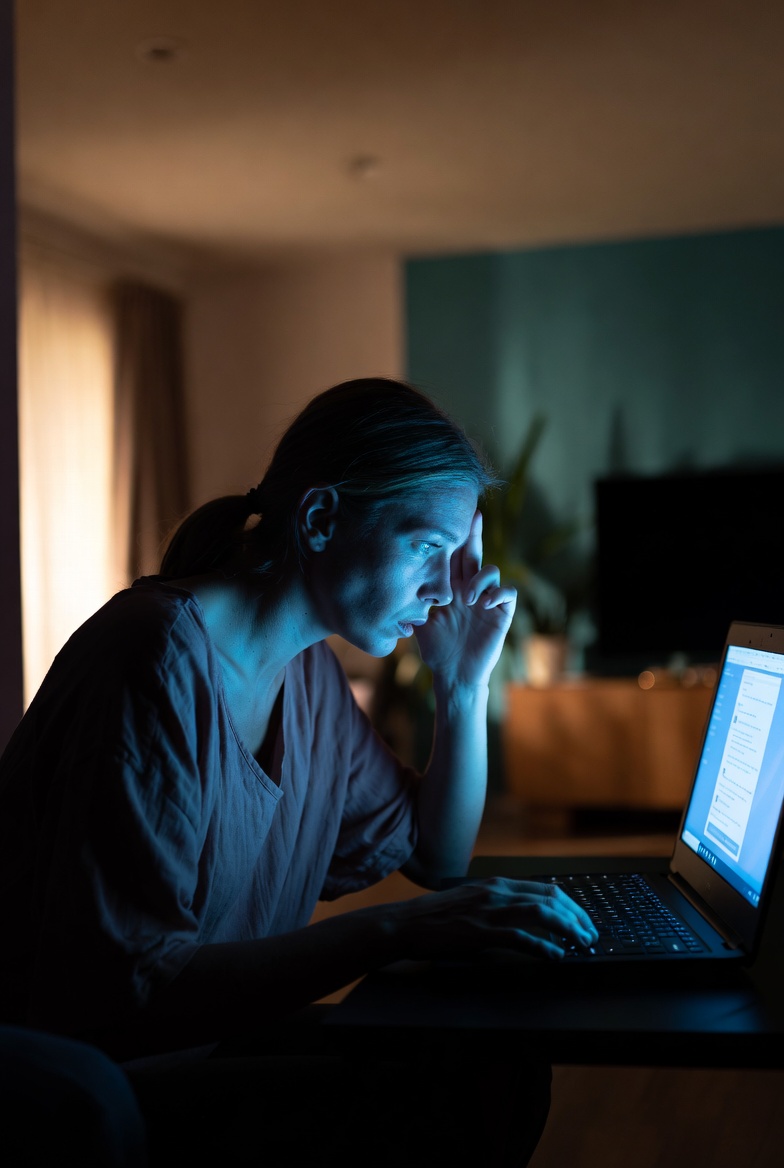
It is 3:17am. You have been awake since 2:52am. You know this because you have checked your phone three times, each time telling yourself you won't check it again.
You went to bed at 11pm. You fell asleep around midnight. For ninety minutes, you slept well. Then something — nothing in particular — woke you, and the moment you were conscious, your brain was already three steps into tomorrow's meeting, mentally rehearsing an email you haven't sent yet, and working out whether the tightness in your chest is stress or something worse.
You have done this every night for a week. Tomorrow you have to function on five hours of fragmented sleep. Your last thought before the next anxiety spike is: I can't keep doing this.
Here is what the neuroscience of this moment actually shows: your brain at 3am is not the reliable narrator your 3am brain thinks it is. The prefrontal cortex — the rational moderator — is at its lowest ebb of the 24-hour cycle. The amygdala is highly reactive from cumulative sleep deprivation. The cortisol curve is starting its pre-dawn rise. All the thoughts feel urgent and true. None of them should be trusted at this hour. And the single most counterproductive thing you can do — lying in bed trying to force sleep — is what you are currently doing.
The bidirectional trap — what is actually happening
The anxiety-sleep cycle is not simply "anxiety makes you think too much at night." It is a cascade of mutually reinforcing neurobiological processes that are genuinely difficult to interrupt from the inside.
How the loop sustains itself
The UC Berkeley research group, led by Matthew Walker, has documented the anxiety-sleep relationship extensively. Their neuroimaging data shows that sleep-deprived subjects exhibit 60% more amygdala reactivity to negative stimuli than those who slept adequately. The prefrontal cortex's regulatory connection to the amygdala is significantly weakened after sleep loss — not as a cognitive consequence, but as a direct neurological one.
What anxiety does to sleep architecture
Most people understand that anxiety makes it hard to fall asleep. Fewer understand what it does to sleep quality once sleep is achieved — which explains why anxious people often wake feeling exhausted even after eight hours in bed.
Sleep occurs in cycles of approximately 90 minutes, moving through light sleep (N1, N2), deep slow-wave sleep (N3), and REM sleep. Anxiety preferentially disrupts the deeper stages. People with anxiety disorders spend significantly more time in N1 and N2 (light sleep) and less time in N3 (restorative deep sleep) and REM. They also experience more nocturnal awakenings — brief arousals that often do not reach full consciousness but fragment the sleep architecture and reduce its restorative quality.
REM sleep in particular is critical for emotional processing. During REM, the brain reprocesses emotional memories and experiences, reducing their emotional charge — a process neuroscientist Walker calls "overnight therapy." Anxiety disrupts REM, meaning emotional experiences from the preceding day are not processed and their negative charge is preserved into the following day. This produces the common experience of anxious people waking with the same unresolved worries that were present at bedtime, seemingly unprocessed by sleep.
The architecture disruption also means that even when the total sleep duration is adequate, the sleep is not doing the restorative work that deep and REM stages provide. The result is subjective exhaustion despite sufficient hours — which many anxious people interpret as evidence of a physical problem rather than a sleep quality issue.
The Architecture
Four things to notice in the anxious version: (1) the 75-minute gap before the first sleep stage begins — that is the sleep-onset latency, time spent lying awake in bed; (2) the almost complete absence of N3 deep sleep — the most restorative stage — appearing for only a brief moment; (3) the four awakenings fragmenting the night, with the longest running from 4am to 5:30am (the classic "3am wake, can't get back to sleep" experience); (4) REM sleep reduced to two brief periods, far less than the four extended periods in the healthy version. This is why anxious sleepers often wake feeling exhausted after 8 hours in bed — the time was there, but the restorative architecture was not.
The meta-anxiety about sleep — a second loop
Once sleep has been poor for several nights, a second anxiety loop typically develops: anxiety about sleep itself. "What if I can't fall asleep tonight?" "I'll be exhausted tomorrow — I won't cope." "What if this becomes permanent?" "I'm already thinking about sleep at 7pm."
This meta-anxiety is often more damaging than the original anxiety. It produces what CBT-I therapists call performance anxiety around sleep — the bed itself becomes a conditioned trigger for wakefulness and anxiety rather than for relaxation and sleep. The harder you try to sleep, the more physiologically aroused you become. The arousal prevents sleep. The failure to sleep confirms the fear. The bed becomes associated with failure.
This mechanism — conditioned arousal in the sleep context — is specifically targeted by stimulus control therapy, one of the core CBT-I techniques.
The critical mistake: Lying in bed awake, trying to force sleep. This is the single most effective way to deepen conditioned arousal and extend the insomnia. The techniques below are specifically designed to interrupt this pattern.
CBT-I — the evidence-based treatment
CBT for Insomnia (CBT-I) is NICE-recommended as the first-line treatment for chronic insomnia, including anxiety-driven insomnia. Multiple systematic reviews confirm it is more effective than sleep medication in the long term, and its effects are durable where medication effects typically fade. CBT-I addresses the maintaining factors of insomnia rather than masking them.
The core CBT-I techniques are sleep restriction, stimulus control, sleep hygiene optimisation, cognitive restructuring targeting catastrophic sleep beliefs, and relaxation techniques.
7 techniques to break the cycle
1 Stimulus control
Use the bed only for sleep (and sex). No reading, screens, worrying, or lying awake in bed. If you are not asleep within approximately 20 minutes, get up and go to a dim, quiet place. Do something calm until you feel sleepy, then return to bed. Repeat as needed.
This feels counterintuitive and uncomfortable, particularly initially. But it is the most powerful technique for breaking the conditioned arousal that develops when the bed becomes associated with wakefulness. Over 1–2 weeks, the association shifts: bed becomes a reliable cue for sleep rather than for anxiety and frustration.
2 Sleep restriction
Temporarily reduce time in bed to match actual sleep time. If you are sleeping 5 hours but spending 9 in bed, restrict to 5.5 hours in bed. This builds sleep pressure — the accumulation of adenosine that drives sleep onset — and consolidates fragmented sleep into deeper, more continuous sleep. Time in bed is gradually extended as sleep efficiency improves.
Sleep restriction is the most evidence-based CBT-I technique and also the most uncomfortable. It produces significant short-term sleep deprivation before the consolidation effect kicks in. It is most safely implemented with professional guidance for severe insomnia, but the principle — reducing time in bed to build sleep pressure — can be applied more gently in self-guided form.
3 The brain dump
30–60 minutes before bed, write down everything on your mind: worries, to-do items, unresolved problems, things you are afraid of forgetting. Do not organise or solve — just transfer. Close the notebook.
James Pennebaker's research on expressive writing shows that externalising concerns reduces cognitive load and improves sleep onset. Your working memory no longer needs to hold the items actively — they are captured. The ritual of closing the notebook signals that the "holding" function has been transferred and can be released for now. For many people this simple practice reduces sleep-onset time noticeably within the first week.
4 Worry postponement
When a worry arises during the night, acknowledge it and explicitly defer it: "I hear you. I'll deal with this at 9am tomorrow." Write it briefly if needed. This is not suppression — which would rebound. It is an accepted deferral. The brain accepts the postponement when the concern is acknowledged and given a specific future time.
The critical element is specificity: "I'll think about this tomorrow" is less effective than "I'll think about this at 9am." The specific time transforms an open loop into a closed one. And when 9am arrives, most night-time worries have lost significant urgency.
5 Cognitive restructuring for sleep catastrophising
Night-time sleep catastrophising follows predictable distortion patterns: "If I don't sleep tonight, I won't function tomorrow" (overestimation of impact), "I need 8 hours or I'll fall apart" (rigid rule), "This is never going to get better" (fortune telling). Each can be challenged with evidence.
The research on sleep deprivation shows that humans are significantly more resilient to acute poor nights than the catastrophic predictions suggest. One bad night impairs performance at the margins, not catastrophically. Most people have survived multiple poor nights and functioned adequately. The catastrophic prediction is a distortion — not an accurate forecast.
6 Grounding for night-time anxiety
The standard 5-4-3-2-1 grounding technique is modified for night use: rather than naming items aloud (which increases alertness), mentally note five textures you can feel in the bed (the weight of the duvet, the temperature of the pillow, the texture of the sheet), then four distant sounds, three bodily sensations, two smells. Keep eyes closed. Breathe slowly throughout.
This version maintains sensory grounding while avoiding the alertness-increasing effects of the standard daytime version. It interrupts the thought loop by filling attentional bandwidth with non-threatening present-moment sensation.
7 The 4-7-8 breath
Inhale through the nose for 4 counts, hold for 7, exhale through the mouth for 8. The extended hold and long exhale directly activate the vagus nerve and parasympathetic nervous system. Four to six cycles. The slight CO2 increase from breath holding counteracts the hyperventilation pattern common in anxiety-driven wakefulness. Unlike box breathing (4-4-4-4), the 4-7-8 ratio is specifically optimised for sleep onset rather than daytime regulation.
Sleep hygiene — the basics still matter
Stimulus control and sleep restriction address the psychological and behavioural maintaining factors. Sleep hygiene addresses the environmental and circadian ones. Both are necessary.
- Light exposure — bright light in the morning (ideally outdoor) anchors the circadian clock and advances melatonin onset. Dim light in the evening (avoiding blue-spectrum screens) allows melatonin to rise on schedule.
- Temperature — core body temperature must drop by approximately 1°C to initiate sleep. A cool bedroom (16–18°C) supports this. A warm bath or shower 1–2 hours before bed paradoxically helps by causing subsequent heat loss.
- Caffeine half-life — caffeine's half-life is approximately 5–7 hours. A cup of coffee at 3pm still has half its caffeine active at 9pm. For anxiety-prone individuals with sleep difficulties, cutting off caffeine by noon is worth trialling.
- Alcohol — alcohol is sedating but profoundly disruptive to sleep architecture. It suppresses REM and increases nocturnal awakenings in the second half of the night. It consistently worsens anxiety the following day through rebound cortisol.
- Consistent wake time — a fixed wake time regardless of when you fell asleep is the single most powerful circadian anchor. It maintains sleep pressure and stabilises the clock even when bedtime is variable.
See anxiety-sleep patterns in specific presentations
- Lisa's morning anxiety case study — the cortisol awakening response, 5am wakings, and what it looks like in a senior professional role
- Sarah's health anxiety case study — three hours of nighttime Googling, and how it compounded the sleep problem on top of the anxiety problem
- Emma's postnatal anxiety case study — anxious sleep monitoring with a newborn, and the specific dynamics of postnatal sleep fragmentation
- Tom's nighttime anxiety case study — 3am wakings and racing thoughts in a Birmingham tradesman, and how stimulus control and brain-dump eventually broke the pattern
Common mistakes that make sleep worse
Before moving to the techniques that work, here are the six most common things people do — often in good faith — that actively maintain anxiety-driven insomnia. Many are standard advice that is wrong for anxious sleepers specifically.
Going to bed earlier to "catch up"
After a bad night, the instinct is to go to bed early the next night. This is the opposite of what CBT-I prescribes. Earlier bedtime reduces sleep pressure, making sleep onset harder, deepening the association of the bed with wakefulness. Keep a consistent bedtime regardless of how tired you feel, and let the sleep pressure build.
Lying in bed trying to force sleep
Minutes of forced wakefulness in bed train the nervous system to associate the bed with stress. The 20-minute rule (stimulus control) exists precisely to interrupt this conditioning. Get up, go to a dim room, return when sleepy. Lying in bed fuming at the ceiling is the behaviour that builds chronic insomnia.
Checking the time when you wake at 3am
The time-check triggers catastrophic calculation: "I have 3 hours left. I need to fall asleep in the next 30 minutes or I'll be exhausted." This activates the HPA axis and guarantees extended wakefulness. Hide the clock. If you must know the time in the morning, set an alarm and trust it.
Napping during the day after bad nights
A daytime nap reduces the sleep pressure you need for that night's sleep, extending the insomnia cycle. Exception: a short 20-minute nap before 2pm is generally fine. Anything longer or later interferes with the core mechanism of CBT-I.
Treating weekends differently
Irregular weekend sleep schedules disrupt the circadian rhythm enough that Monday night feels like jet lag. A consistent wake time 7 days a week is far more effective than any sleep hygiene tweak. If you must shift, shift by no more than an hour.
Using alcohol to fall asleep
Alcohol works as a sedative for the first hours of sleep, which is why it feels helpful. It then disrupts sleep architecture in the second half of the night and produces rebound anxiety in the morning via cortisol. The cost comes due later in the night; the benefit is only in the first half. Net effect on anxiety: negative.
Stop The Loop's nighttime mode is designed for 3am — guiding you through techniques that bring you toward sleep rather than full alertness. Calmer. Quieter. Adapted to the specific anxiety profile of the night hours. Try it free.