A wanted pregnancy, an unexpected battle
Emma had planned for this baby for two years. She'd read every parenting book, attended every antenatal class, painted the nursery, and felt genuinely ready. What nobody prepared her for was the anxiety that arrived with her daughter like an uninvited guest and refused to leave.
It started in the hospital. Emma noticed that her newborn daughter, Lily, would occasionally pause between breaths — a completely normal newborn breathing pattern called periodic breathing. Emma's brain interpreted it as respiratory distress. She pressed the nurse call button. The nurse assured her Lily was fine. Emma believed her — for about twenty minutes. Then she noticed another pause and pressed the button again.
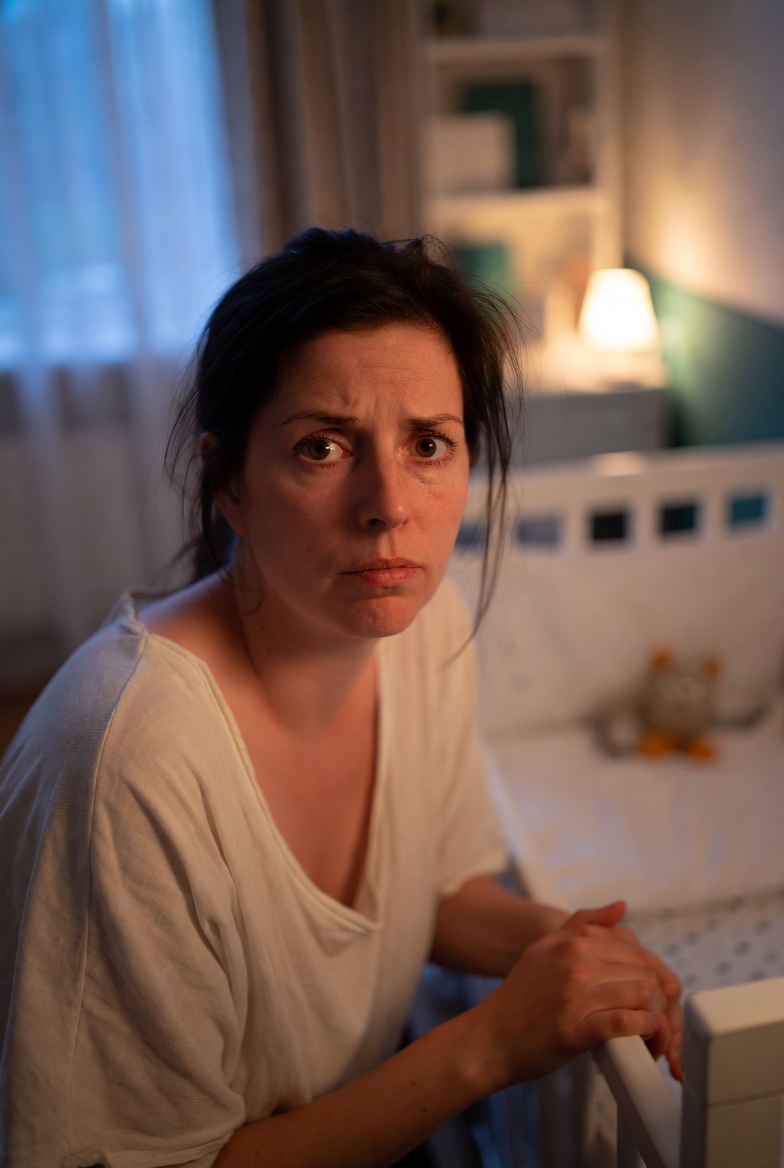
By the time Emma went home, she was checking Lily's breathing every 15-20 minutes. She'd lean over the cot, hold her hand near Lily's face to feel for breath, and watch the rise and fall of her tiny chest. If Lily was particularly still, Emma would gently touch her — just to make sure. She set alarms through the night. She couldn't sleep between checks because she was counting down to the next one. Within two weeks, Emma was sleeping less than 3 hours per night in fragmented bursts.
Her partner, David, tried to help. He offered to take over the night checks. But Emma couldn't let go — what if he fell asleep and missed something? What if he didn't check properly? What if the one time she wasn't watching was the time something went wrong? The catastrophic thought was always the same: 'If I stop checking, she'll die. And it will be my fault.'
How the checking cycle maintained itself
Emma's postnatal anxiety followed the classic health anxiety pattern, but applied to her baby instead of herself. The trigger was a normal sensation (Lily's periodic breathing). The catastrophic interpretation was 'she's stopped breathing.' The safety behaviour was checking. The temporary relief from checking was immediately undermined by the thought: 'But what about next time?'
The checking provided no lasting reassurance because the feared event (sudden infant death) is, by definition, unpredictable. No amount of checking can guarantee it won't happen. Emma was seeking certainty in a situation where certainty is impossible — and each failed attempt to achieve certainty drove more checking. The frequency escalated from every 30 minutes to every 15 minutes to standing over the cot for hours, watching Lily breathe, unable to look away.
Exhaustion compounded everything. Sleep deprivation impairs the prefrontal cortex — the brain region responsible for rational evaluation. Emma's capacity to reality-check her catastrophic thoughts was being systematically destroyed by the very anxiety that required rational evaluation. She was too tired to think clearly, and her unclear thinking made the anxiety worse, which made sleep more difficult, which made thinking less clear. A vicious cycle within a vicious cycle.
Checking more, sleeping less, functioning worse
The breathing monitor trap: Emma bought an expensive baby breathing monitor. For three days, she felt better. Then the monitor produced a false alarm — a beep when Lily was fine. The false alarm didn't reassure Emma that the monitor was overly sensitive. It terrified her: 'What if next time it's real?' She went back to manual checking in addition to the monitor. Now she had two systems to maintain, and twice the anxiety.
Researching SIDS: In a pattern identical to health anxiety Googling, Emma read everything she could about sudden infant death syndrome. She memorised risk factors, statistics, and case studies. Each piece of information was filtered through her catastrophising lens — not 'SIDS is extremely rare' but 'it can happen to anyone, even when you do everything right.' The research didn't reduce her anxiety. It gave it more material.
Isolating from support: Emma stopped accepting visitors because she couldn't check on Lily while socialising. She cancelled her postnatal group because leaving the house meant leaving Lily with David, and she couldn't tolerate the uncertainty of not being there to check. Her support network — the thing she needed most — was the thing her anxiety was dismantling.
The turning pointNaming the condition
Emma's GP, during a postnatal check-up, asked a screening question: 'Do you find yourself checking on the baby more than feels necessary?' Emma burst into tears. For the first time, she told someone the full extent of what was happening: the 15-minute checks, the 3 hours of sleep, the inability to let David help, the constant terror.
The GP's response was transformative: 'This is postnatal anxiety. It's a recognised condition. It's not your parenting instinct — it's a clinical anxiety presentation. And it's very treatable.' For Emma, being told that this was a condition — not a rational response to danger, not a sign of good parenting, not something she should push through — was the turning point. She wasn't a diligent mother. She was an anxious mother. And anxiety responds to treatment.
The techniques that helpedHow Emma broke the checking cycle
1. Response prevention (graduated). Emma couldn't go from checking every 15 minutes to not checking at all — the anxiety would have been unbearable. Instead, she gradually extended the interval: 15 minutes → 20 minutes → 30 minutes → 1 hour → 2 hours → only at feeds. Each extension felt terrifying at first. But each time Lily was fine, Emma's brain received corrective evidence: 'I didn't check for 30 minutes and nothing bad happened.' Slowly, the urgency of the checking impulse reduced.
2. Cognitive restructuring. Emma's core thought — 'If I stop checking, she'll die' — was subjected to evidence-based scrutiny. Evidence for: none (there is no evidence that maternal vigilance prevents SIDS). Evidence against: millions of babies sleep safely without 15-minute checks; Lily's risk factors were minimal; the monitor provides continuous monitoring; David is a competent parent. Balanced thought: 'Lily is safe. Checking every 15 minutes does not make her safer. My anxiety is making me check, not a real threat to her safety.'
3. Sharing responsibility with David. Gradually, Emma allowed David to take over nighttime checks — first for one hour, then two, then a full night. Each time, Lily was fine. Emma's brain learned that safety didn't depend exclusively on her vigilance — that other people could keep her daughter safe. This was essential for breaking the personalisation distortion ('only I can protect her').
4. ACT acceptance. Emma had to accept a profoundly uncomfortable truth: she could not guarantee her daughter's safety. No parent can. ACT helped her sit with this uncertainty rather than trying to eliminate it through checking. 'I cannot control every risk. I can be a loving, present, and attentive parent. That is enough.'
5. Stop The Loop for nighttime urges. When the 3am checking urge was overwhelming, Emma used the app's nighttime mode. The AI recognised the postnatal anxiety pattern and guided her through response prevention support — acknowledging the urge, sitting with the discomfort, using breathing techniques to manage the acute anxiety, and reminding her of the evidence that Lily was safe. It replaced the checking ritual with a coping ritual.
10 weeks later
Emma checks on Lily at feeds and before she goes to bed — which is what most parents do. The 15-minute checks have stopped entirely. She sleeps when Lily sleeps, getting 5-6 hours most nights (normal for a mother of a 4-month-old). She's re-joined her postnatal group. She lets David do bedtime independently twice a week.
The anxiety still flickers — particularly when Lily is unwell or when Emma reads a news story about child illness. But the checking compulsion has been broken. When the urge arises, Emma notices it, names it ('that's the anxiety, not a real threat'), and redirects her attention. The urge passes within minutes. It used to control her entire day.
Key takeawaysWhat Emma's story teaches us
Postnatal anxiety is a clinical condition, not good parenting. Compulsive checking doesn't keep babies safer — it keeps mothers exhausted, isolated, and unable to function. It needs treatment, not admiration.
Checking is a compulsion, not a precaution. There's a difference between reasonable monitoring and anxiety-driven compulsive checking. When checking increases in frequency without improving outcomes, it's a compulsion.
Response prevention works, even when it feels dangerous. Gradually extending the interval between checks provides corrective evidence that the checking isn't necessary. It's frightening. It's also the treatment.
Accepting uncertainty is not negligence. No parent can guarantee their child's safety. Accepting this — truly accepting it, not just intellectually acknowledging it — is the key to breaking postnatal anxiety's grip.