Ten years on the road, forty seconds that changed it
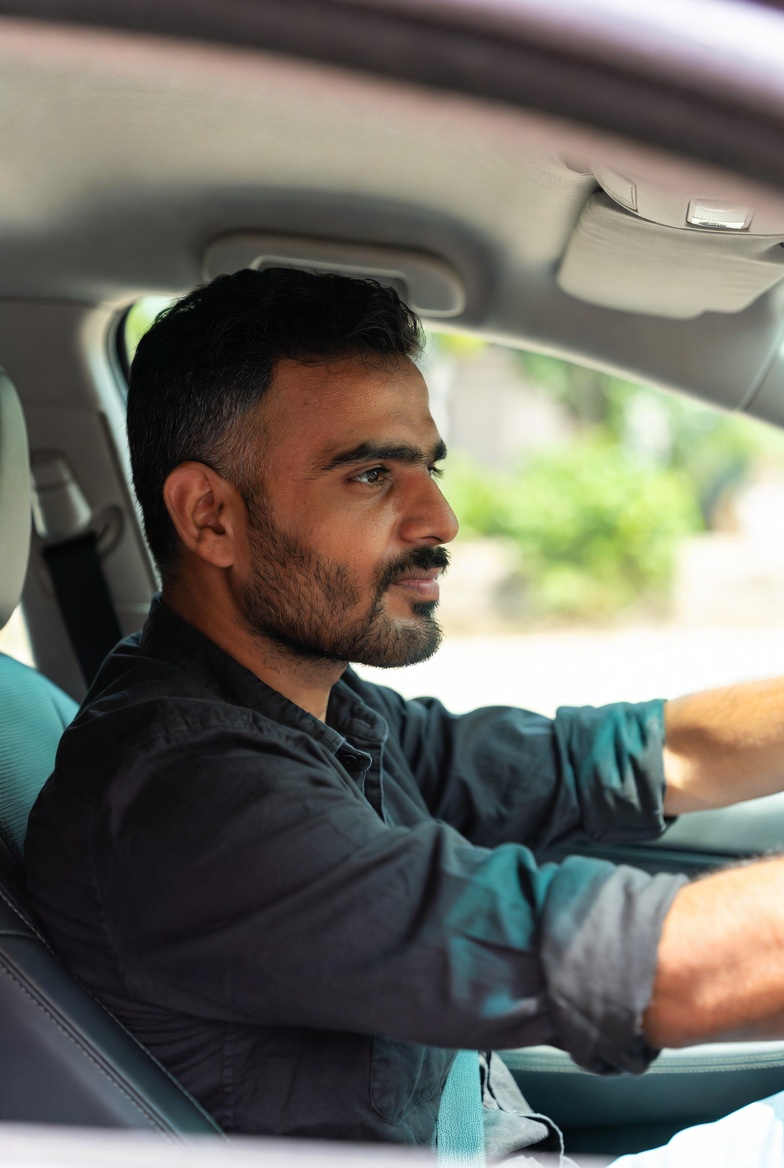
Ahmed had been driving for a living for ten years. He'd started in taxis at 23, moved into courier work at 26, and for the last four years had been doing regional parcel delivery \u2014 Bradford out to Leeds, Manchester, Sheffield, and back, five days a week, sometimes six. He was good at it. He was fast without being reckless, he knew the roads, and he'd never had so much as a points-on-the-licence moment. Driving was the thing he did \u2014 not just for money, but as a part of who he was. He had felt, until that February morning on the M62, almost unshakably at ease behind a wheel.
The accident itself lasted maybe forty seconds. He was doing 55mph in the middle lane near junction 26, on his way to a depot in Leeds. It had started raining hard about ten minutes earlier. The van in front of him braked suddenly \u2014 hard, far harder than the conditions warranted \u2014 because a car had cut across lanes without warning. Ahmed braked. The rain meant his stopping distance was longer than he'd registered. He went into the back of the van at maybe thirty miles per hour. The airbag deployed. His seatbelt locked. The windscreen cracked diagonally across the passenger side. For a few seconds, he couldn't tell whether he was conscious.
He was. The van driver was fine. Ahmed was shaken but, somehow, physically okay \u2014 a bruised chest from the seatbelt, a headache that lasted three days, no broken bones. The paramedics checked him over at the scene and said he was lucky. The police took statements. A recovery lorry took his van away. Someone from his depot came out to drive him home. By 4pm the day of the accident, Ahmed was on his own sofa, drinking tea, watching his hands tremble, and telling himself how lucky he'd been.
He was off work for two weeks while the van was repaired. The plan was to return to his normal route on the Monday of week three. That Monday morning, he got dressed, put his keys in his pocket, walked out to the van, and sat in the driver's seat. He turned the key. He put the van in gear. He got to the end of his own street, reached the junction with the main road, and found he couldn't turn onto it. His heart was pounding. His chest was tight. His hands were gripping the wheel so hard his knuckles had turned white. He reversed back into his drive, walked into the house, and sat on the floor.
That was the start of seven months of a life he hadn't planned for.
Driving anxiety or PTSD?
One of the most important things Ahmed learned, eventually, was that what he was experiencing wasn't simply "driving anxiety." It was Post-Traumatic Stress Disorder with a driving-specific presentation \u2014 and this distinction mattered for treatment.
PTSD after a road traffic accident is common, underdiagnosed, and has a specific clinical picture. The core features are:
- Intrusive memories of the accident \u2014 flashbacks, images, or sensations that replay unbidden, often triggered by something as small as rain on a windscreen or the smell of petrol
- Hypervigilance while driving \u2014 constant scanning for threats, inability to relax, exaggerated response to other drivers' behaviour
- Avoidance \u2014 of driving entirely, of specific roads or conditions, of anything that resembles the accident
- Sleep disturbance and nightmares \u2014 frequently about the accident itself or variations of it
- Mood changes \u2014 irritability, low mood, feeling disconnected from others
- Exaggerated startle response \u2014 jumping at brake lights, horns, sudden noises
Ahmed had all of these. He was having flashbacks every time a van in front of him braked. He could not drive in the rain without his heart rate spiking and his hands going clammy. He was having two or three nightmares a week, most of them variations on the accident \u2014 sometimes the van brakes and he can't, sometimes it's his own children in the car with him, sometimes the crash is worse. He had become irritable at home with his wife and children in a way that was unlike him. He jumped when the dog barked.
The distinction between driving anxiety (an anxiety disorder) and PTSD (a trauma disorder) matters because they respond to slightly different treatments. Standard CBT helps driving anxiety. PTSD responds better to trauma-focused CBT or EMDR (Eye Movement Desensitisation and Reprocessing) \u2014 both NICE-recommended treatments in the UK that specifically target the way traumatic memories are stored in the nervous system. Ahmed had been trying to do graded exposure without addressing the underlying trauma, and it hadn't been working. Getting the right diagnosis was what unlocked the right treatment.
If you're reading this after an accident of your own: If you have intrusive memories, nightmares about the event, hypervigilance, or find yourself re-experiencing the accident in your body, please ask your GP specifically about PTSD assessment. Trauma-focused CBT and EMDR are different from standard CBT and may be what you need. You can self-refer to NHS Talking Therapies in most of England and Wales \u2014 you do not always need to wait for a GP appointment.
What driving actually felt like
For the seven months between the accident and the start of effective treatment, every time Ahmed tried to drive, a sequence played out almost identically:
1. Anticipatory anxiety before getting in the van. Walking towards the vehicle was enough to trigger the first wave. Heart rate elevated. Chest tight. A knot in his stomach. The part of his brain that handles threat detection was already firing, before he'd turned the key.
2. Hypervigilance on starting to drive. Once on the road, his attention narrowed. He was aware of every car ahead, every car behind, every brake light, every movement in a neighbouring lane. Music off. No radio. He needed every sensory channel available to scan for danger. This felt, to him, like being careful. It was actually the nervous system operating at the level of someone walking through a minefield.
3. Speed suppression. He literally could not physically press the accelerator past 30mph. It wasn't that he decided not to \u2014 his body refused. When other drivers overtook him or tailgated him, the anxiety only increased, because he could not speed up to resolve the situation. He became, unintentionally, the kind of slow-moving hazard that frustrates other drivers and increases risk for everyone.
4. The flashback trigger. Certain cues would instantly transport him back to the accident. Brake lights in rain. The sound of a van horn. A sudden lane change ahead of him. The smell of the road after a downpour. Each of these produced a rush of physical sensations identical to the original accident \u2014 racing heart, tunnel vision, sweating, a lurch in the stomach. His body was re-experiencing a forty-second event that had ended months ago.
5. The exit. At some point on most journeys, the anxiety would cross a threshold and Ahmed would have to stop. An A-road lay-by. A service station. Twice, the hard shoulder of a motorway \u2014 which is not safe or legal \u2014 because he could not continue. He would sit in the cab trying to breathe for ten or fifteen minutes, sometimes longer, before feeling able to move again.
6. The shame afterwards. Every failed journey came with a wave of self-criticism. You're pathetic. You've driven for ten years. It was a minor accident. Other people have much worse and they cope. Get a grip. The shame didn't motivate him to try harder. It just compounded the anxiety about the next attempt.
When anxiety isn't just anxiety \u2014 it's your livelihood
Most mental health case studies focus, reasonably, on the internal experience of the anxiety. For Ahmed, there was another layer that is too often left out of these conversations: the financial and practical consequences of not being able to do the job that pays your mortgage.
Three weeks after the failed return to work, Ahmed's courier company offered him a choice. Either return to full motorway routes within another two weeks, or accept a local-only delivery role that paid forty percent less. There was no halfway option. He took the local role because the alternative was no job at all. The income drop was immediate and brutal. His wife, who had been working four days a week, took on a fifth. They cancelled the family holiday they'd booked for Easter. They stopped the direct debit for his oldest son's football club. They had conversations at the kitchen table about whether they'd be able to keep up with the mortgage if things didn't improve in the next six months.
This is the hidden face of mental health in working-class and lower-middle-income households. Therapy advice that says "take a few weeks off, prioritise your recovery, be kind to yourself" lands differently when taking a few weeks off means you can't pay your bills. The NHS waiting list for CBT in Ahmed's area was six months at the time. Private therapy was \u00a380 a session minimum. There was no easy "just wait for the right treatment" option. The clock on his recovery was also the clock on his family's finances.
Ahmed later learned two things that would have helped him earlier. First: psychological injury after a road traffic accident can be part of a personal injury claim, particularly if another driver was at fault. PTSD and driving anxiety are recognised injuries under UK personal injury law. A solicitor specialising in RTA claims can advise on whether you have a case. Many firms work on a no-win-no-fee basis, and settlement can fund the faster private treatment that NHS waiting lists make inaccessible. Second: Citizens Advice offers free guidance on benefits and financial support when a medical issue is affecting your ability to work. Statutory sick pay, Universal Credit, and Personal Independence Payment can all be relevant \u2014 and none of them are luxuries; they exist for exactly this situation.
What didn't workThe strategies that prolonged the problem
Before Ahmed got proper treatment, he tried almost everything else first \u2014 the normal sequence of things people in his position try, because it's what the world tells them to do.
"Just getting back on the horse"
The instinct, backed up by well-meaning advice from mates, family, and the internet, was to force himself to drive the exact road where the accident had happened. Do the motorway. Face the fear. Get it over with. He tried it three times in the first month. Each attempt ended with him pulling onto the hard shoulder, breath ragged, panic flooding his body. Far from curing the fear, each failed attempt made the next one worse \u2014 the nervous system learned not that the road was safe, but that the road was terrifying, that his body couldn't cope with it, and that attempting it was humiliating.
There is a version of exposure therapy that looks a bit like this, but it only works when done gradually and under the right conditions. "Just getting back on the horse" is the wrong version. Done badly, it's retraumatising rather than therapeutic.
Taking a beer before driving
This is not something Ahmed is proud of, and he will be the first to tell anyone who'll listen that it's not a strategy he recommends. But for about four weeks during the worst period, he would drink a single bottle of lager before getting in the van for short local journeys \u2014 just enough, he told himself, to take the edge off without being over the limit. It felt like it helped in the moment. It also meant he was driving impaired. He stopped when his wife found a bottle in the kitchen bin on a Tuesday morning and the horrified look on her face landed harder than any advice had.
This is not an unusual mistake for people with driving anxiety. Alcohol or sedative use as a driving-anxiety management strategy is dangerous, doesn't work long-term, and often leads to worse problems. It's also a signal that someone needs proper help, urgently, not more willpower.
Driving at 30mph on 60mph roads
Ahmed spent weeks driving everywhere at 25\u201330mph \u2014 on residential streets, A-roads, and dual carriageways alike. This felt safer to him. It was actually making him a hazard to other road users, attracting horns and furious overtaking manoeuvres, and consolidating his brain's belief that anything faster than 30mph was genuinely dangerous. Driving-anxiety work eventually needs to include speed. Refusing to drive at normal speeds is not a solution; it's a symptom.
Taking wild detours
Adding twenty miles to a journey to avoid a specific stretch of A-road where the accident had happened. Adding forty-five minutes to a trip to avoid the motorway entirely. Refusing jobs that required certain routes. Every detour felt rational in the moment. Taken together, they were teaching his brain that those roads were genuinely dangerous and required avoidance \u2014 the opposite of what recovery required.
Keeping it private
Ahmed told his wife some of it. He did not tell his parents, his friends, his old colleagues, or anyone at his new job. The things he'd always prided himself on \u2014 being reliable, being strong, being the one people could count on \u2014 made admitting that he was scared of driving feel intolerable. The isolation compounded the problem. He was carrying something that would have been significantly lighter if shared, and he was denying himself access to practical help from people who would have given it gladly.
The first GP appointment
Ahmed did see his GP, about eight weeks after the accident. He described the anxiety, the flashbacks, and the inability to work. The GP, who was competent but time-pressured, suggested it was "understandable" after an accident and that it would "probably settle in time." He suggested a sick note if Ahmed wanted one and offered to review in a few months. Crucially, he did not mention PTSD, did not refer to NHS Talking Therapies, and did not screen for trauma symptoms. This isn't rare \u2014 PTSD after road traffic accidents is underdiagnosed even within primary care. Ahmed left the appointment feeling, reasonably, that the NHS had looked at his problem and decided it wasn't urgent.
It was. He went back three months later, this time having read up on PTSD himself, and specifically asked for an assessment. The second GP referred him to NHS Talking Therapies with a specific note about possible PTSD. The right treatment began within another six weeks. The lesson: sometimes you have to know what to ask for.
The turning pointThe morning his son asked why Daddy was sad
Ahmed can tell you the exact moment that shifted his determination to get proper help. It was a Saturday morning in late July, about five months after the accident. He was making breakfast for his two children \u2014 eight and five \u2014 and his youngest, unprompted, looked up from his cereal and asked: "Daddy, why are you always sad now?"
He hadn't realised his children had noticed. He had thought he was hiding it. He had not been hiding it. He had been distracted, irritable, withdrawn, quieter, less available than he used to be, and the children \u2014 who are much better observers than adults give them credit for \u2014 had clocked every bit of it.
That afternoon, Ahmed rang the GP surgery and booked a second appointment with a specific ask: he wanted to be assessed for PTSD. He went in three days later with notes he'd written on his phone. The GP listened, asked the screening questions, and wrote a referral letter that specifically mentioned post-traumatic stress disorder and requested trauma-focused CBT. Six weeks later, he started weekly sessions with a therapist who specialised in trauma.
He also, for the first time, told his brother and his two closest friends what had been happening. Their response \u2014 immediate, unsurprised, entirely supportive \u2014 was a piece of medicine he hadn't realised he needed. One friend drove him to his first therapy session. His brother started coming with him on practice drives while he did his graded exposure work. The wall he'd built around the problem came down, and the problem turned out to be much easier to carry when other people could see it.
How Ahmed got back behind the wheel
What follows are the specific techniques Ahmed used over the ten weeks of his active treatment. These are drawn from trauma-focused CBT, standard CBT for anxiety, and evidence-based practice for driving phobia specifically. The work was structured, gradual, and for the first few weeks, felt painfully slow. The speed is the point.
1 Understanding what trauma does to the nervous system
The first two sessions of therapy were largely psychoeducation. Ahmed learned what happens in the brain during a traumatic event \u2014 how the amygdala imprints the threat, how the hippocampus's ability to contextualise is impaired during high stress, how the traumatic memory gets stored differently from ordinary memories and intrudes on the present. This wasn't just interesting. It helped him stop interpreting his symptoms as signs of weakness and start interpreting them as predictable neurological responses to a real event. The shift from "I'm broken" to "my nervous system did what nervous systems do" was, in itself, part of the treatment.
2 Processing the traumatic memory (trauma-focused CBT)
In structured sessions, Ahmed's therapist guided him through detailed narration of the accident \u2014 over and over, from start to end, recording what happened, what he saw, what he felt in his body. The first time was almost unbearable and Ahmed cried through most of it. The tenth time, he could describe the same forty seconds with much less physiological arousal. The brain was learning, through repeated controlled exposure, that the memory was a memory \u2014 not a current threat. This is the core mechanism of trauma-focused CBT, and it cannot be short-cut by talking about the accident casually. It requires structured, therapist-led re-exposure.
3 Building the fear ladder
Ahmed and his therapist co-created a specific hierarchy of driving situations, ranked by predicted anxiety (0\u2013100). A sample of the actual ladder: (1) Sit in parked van, engine off \u2014 15. (2) Sit in parked van with engine running \u2014 25. (3) Drive 10 metres forward and back on the drive \u2014 35. (4) Drive around the residential block once \u2014 45. (5) Drive to the local shops, park, return \u2014 55. (6) Drive a quiet A-road for five minutes \u2014 65. (7) Drive a dual carriageway for one junction \u2014 75. (8) Drive the motorway for one junction \u2014 85. (9) Drive the motorway route where the accident happened \u2014 100. Each step was practised multiple times until the anxiety reliably reduced before moving up.
4 Anxious-driver lessons with a specialist instructor
Ahmed paid \u00a340 an hour for three lessons with a local driving instructor who specifically offered tuition for anxious or post-accident drivers. The instructor was calm, patient, and genuinely understanding \u2014 not "come on, just do it," but "we'll do what you can do today, and a little bit more next time." These lessons were invaluable for the middle of the fear ladder \u2014 the bits that were too difficult to do alone but not quite ready for therapy homework yet. Several UK driving schools offer this service specifically. It's not hand-holding; it's part of evidence-based graded exposure.
5 Grounding techniques in the vehicle
For the acute moments during driving, Ahmed learned specific in-vehicle grounding techniques. The 5-4-3-2-1 technique adapted for driving \u2014 naming five things he could see on the road, four things he could feel (steering wheel, seat, seatbelt, accelerator), three sounds (engine, tyres, wind), two smells (if any), one taste. Box breathing while stationary in traffic. Cold water on the face when stopped at a service station. These didn't eliminate the anxiety \u2014 they created enough of a window for him to continue rather than stop.
6 Cognitive restructuring about driving risk
Ahmed's brain was treating driving as if every journey were likely to end in another accident. The actual statistics tell a very different story. UK road death rates are, per mile driven, extraordinarily low. A person in Ahmed's demographic doing the mileage he was doing could, statistically, drive for decades without a serious accident. These numbers didn't make the anxiety disappear. But they did provide an objective counter-narrative to his brain's catastrophic prediction that the next journey was likely to kill him.
7 Behavioural experiments
Specific predictions, tested. Prediction: if I drive on the motorway for one junction, I will have a panic attack and have to pull over. Test: drive one junction on the motorway (with his brother in the passenger seat for safety). Outcome: anxiety rose to 70, peaked at 75, started to reduce by the time he reached the exit slip road. No panic attack. No pullover. Each experiment produced evidence that his catastrophic predictions were systematically wrong. Over weeks, the evidence accumulated faster than the anxiety could explain it away.
8 Re-introducing music and a passenger, then removing them
This was a specific part of the exposure protocol. In the earliest stages, Ahmed drove in silence with no passenger \u2014 so his whole attention could be on the driving. In the middle stages, he added calm music and, sometimes, a calm passenger (his brother, usually), both of which helped regulate his nervous system. In the later stages, both were deliberately removed, so the final stages of the ladder were completed alone and in silence. This graduation was important \u2014 otherwise the music and passenger become safety behaviours that have to be present for him to drive, and his independence is compromised.
9 ACT values work
Ahmed's therapist asked him to name what he wanted his life to look like in a year's time \u2014 not in terms of being anxiety-free, but in terms of what mattered. He named: being a good dad, being a reliable husband, doing work he was proud of, being financially secure. Every action in his recovery could then be tested against those values. Driving his son to football club fitted his values. Avoiding the motorway for the rest of his life did not. Values-based motivation proved more sustainable than willpower. When the anxiety was telling him not to drive, his values were telling him why it mattered that he did.
10 Stop The Loop for the acute moments
In the middle weeks of the recovery, Ahmed used the app's emergency spiral mode when the anxiety spiked during exposure work \u2014 the moments between exposures, the moments sitting in the van before starting, the difficult evening after a hard practice drive. The AI guided him through grounding, identified the specific distortion he was running, and reminded him of the written evidence he'd already built up. It acted as external scaffolding for the techniques while they were becoming automatic. He continued using the mood-tracking feature after recovery because it gave him early warning when anxiety started to creep back in \u2014 for example, after a difficult near-miss on the road.
The Leeds run
Ten weeks into his recovery, Ahmed drove the Bradford-to-Leeds run \u2014 the exact route where the accident had happened \u2014 solo. He chose a dry Tuesday morning in off-peak traffic, which was a concession to his still-elevated anxiety. He wasn't pretending to be fully recovered. He was practising being functionally recovered enough to do the job.
The anxiety was real. He felt his heart rate rising as he approached junction 26. He had a flashback moment when a van braked in front of him \u2014 a familiar, unbidden surge of physical sensations that he rode through using the grounding techniques. But he did the route. He arrived at the depot. He drove back. He did not have to pull over. He did not have to stop. He sat in the cab in his own drive afterwards for about ten minutes, trying to process what had just happened, before walking inside to tell his wife.
Two weeks later, his old courier company accepted him back on regional routes. Within four weeks, he was doing motorway routes full-time again. The pay cut reversed. The mortgage pressure eased. The family holiday, now rescheduled for the October half-term, went ahead.
Where Ahmed is nowFifteen months after the accident
Ahmed is back on his original courier routes, doing full motorway driving five days a week. He still occasionally has a flash of elevated anxiety \u2014 a rainy day on the M62 with heavy traffic can still trigger a brief physical response \u2014 and when it happens, he uses the techniques he has now practised hundreds of times. Grounding. Breathing. Naming the distortion. Reminding himself that this is his nervous system remembering, not a current threat.
The flashbacks have largely stopped. The nightmares come back occasionally during stressful weeks but are rare. His mood has stabilised. He is present with his children again in a way he hadn't realised he'd stopped being. His youngest has not asked why Daddy is sad in over a year.
He now quietly mentors two other drivers at his depot who have had accidents and are going through the same process he went through. He has talked his own brother into seeing a GP about long-standing low mood. He is, in a way he wasn't before, public about having had PTSD and having been treated for it. The treatment, he says, cost him nothing \u2014 NHS Talking Therapies was free. The private driving lessons cost him \u00a3120 for three hours. The rest was time and the willingness to do things that felt very hard.
If you've had an RTA and driving has become difficult
If you're reading this because you've had a road traffic accident and driving has become much harder than it was before, there are a few things worth knowing.
What you're experiencing is common and treatable. Psychological impact after a road traffic accident is not evidence that something is wrong with you. It is a normal response to an abnormal event. A meaningful minority of people who experience RTAs develop persistent anxiety or PTSD symptoms. Treatment for this is well-established and, in the UK, available on the NHS.
Ask specifically about PTSD assessment if symptoms persist. If you are having intrusive memories, nightmares, hypervigilance, or flashbacks more than a few weeks after the accident, standard reassurance that it will "pass with time" may not be enough. Ask your GP specifically about PTSD and about trauma-focused CBT or EMDR. Both are NICE-recommended treatments.
Self-refer to NHS Talking Therapies. In most of England and Wales, you can self-refer to NHS Talking Therapies without a GP appointment. Search "NHS Talking Therapies [your area]" to find your local service. Waiting times vary but self-referral is often faster than waiting for a GP to refer you.
Graded exposure works when done properly, and doesn't when done badly. "Just getting back on the horse" is not graded exposure. Proper graded exposure is structured, gradual, and uses a fear ladder. It is best done with a therapist or a specialist driving instructor, not alone.
Consider a personal injury claim if the accident wasn't your fault. Psychological injuries are recognised under UK personal injury law. If another driver was at fault, you may be able to claim for both physical and psychological impact. A solicitor specialising in RTA claims can assess whether you have a case, often on a no-win-no-fee basis. Settlement can fund private treatment that supplements or replaces NHS support.
Specialist driving instructors can help. Search for "anxious driver lessons" or "post-accident driving tuition" in your area. Many UK driving instructors offer this specifically. It's not expensive compared to private therapy and can be a practical bridge in the middle of graded exposure.
Financial support exists. If the accident is affecting your ability to work, Citizens Advice (citizensadvice.org.uk) can advise on Statutory Sick Pay, Universal Credit, and Personal Independence Payment. These are not luxuries \u2014 they exist for exactly this situation.
For families and employersIf someone you know is struggling after an accident
Believe them. The person who walked away from an accident physically fine and is now struggling to drive is not exaggerating. Psychological impact is real and does not correlate with physical injury severity.
Don't push them to "get back on the horse." Well-meant "just drive it out" advice usually makes things worse by forcing failed exposures that consolidate the fear. Support them in seeking proper, graduated help instead.
Offer practical help. Driving to appointments. Accompanying practice drives. Taking on logistical load. These are far more useful than pep talks.
If you're an employer: a formal occupational health referral, a phased return to driving duties, and temporarily different route types are all reasonable adjustments. Many RTA-related mental health issues are covered under the Equality Act 2010 as they can amount to a disability, meaning employers have a legal duty to consider adjustments. Treating driving anxiety as a temporary health issue that responds to proper support produces far better retention than treating it as underperformance.
Key takeawaysWhat Ahmed's story teaches us
Driving anxiety after an accident is often PTSD, not just anxiety. The distinction matters because treatments differ. Trauma-focused CBT and EMDR work better than standard CBT for trauma presentations. Ask specifically.
"Just getting back on the horse" is not exposure therapy. Done badly, forced exposure retraumatises the nervous system. Done properly, graded exposure up a structured fear ladder is one of the most effective treatments available.
Financial pressure is a mental health issue. Mental health advice that ignores the reality of losing income is incomplete. Personal injury claims, Statutory Sick Pay, Universal Credit, and Citizens Advice exist for exactly this situation. Using them is not a failure \u2014 it's the system working.
Specialist driving instructors exist and are worth it. A few hours with an anxious-driver specialist can unlock the middle of the fear ladder in a way that home practice alone sometimes can't.
Primary care doesn't always catch PTSD. If your GP isn't asking the right questions, come back with the right questions yourself. Bring notes. Ask specifically about trauma symptoms. You know your experience better than a ten-minute appointment can assess in one sitting.
Recovery is possible and sustainable. Ten weeks of structured treatment, continued practice afterwards, and the willingness to ask for help turned an apparent career-ending anxiety into a manageable chapter in a continuing life. It is not automatic. It is available.