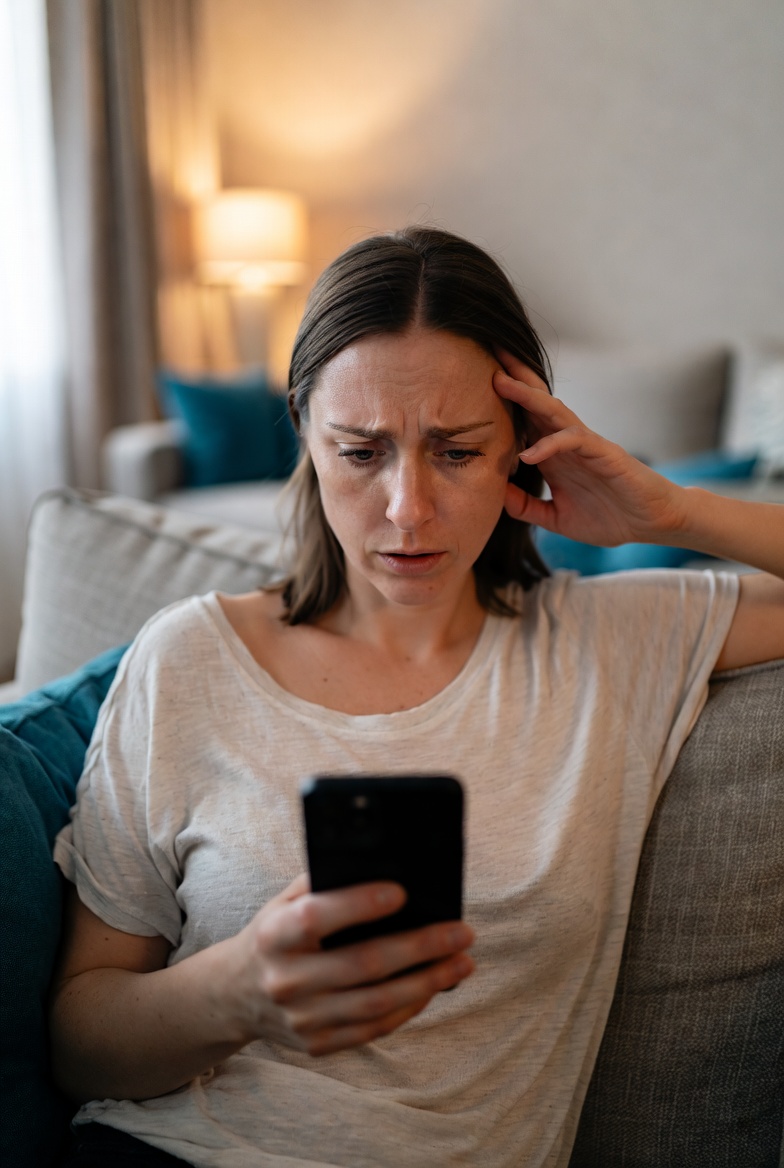
A confident child, an anxious student
Priya had been outgoing throughout school — involved in drama, debating, and student council. The transition to university in Leeds changed everything. Suddenly she was surrounded by strangers, in lecture halls of 200 people, with none of the social structures that had supported her confidence at school. She felt invisible, small, and constantly observed.
It started with a single incident in her first week. Priya asked a question in a seminar and stumbled over her words. Someone smiled — probably kindly, probably encouragingly — but Priya's brain interpreted it as mockery. The thought was instant and absolute: "They think I'm stupid." From that moment, a cascade of avoidance began. She stopped asking questions. Then she started sitting at the back. Then she started arriving late to avoid the walk to her seat with everyone watching. Then she stopped going entirely.
By the middle of her first term, Priya was attending fewer than half her lectures. She was submitting coursework (she could do that alone, from her room) but her participation grade was suffering. She'd stopped going to the student union, stopped accepting invitations to social events, and was spending most of her time in her room, watching lecture recordings and ordering food delivery to avoid the campus canteen.
The loneliness was devastating. Priya wasn't an introvert who preferred solitude. She desperately wanted connection. She just couldn't tolerate the anxiety that came with it. Every social interaction felt like a performance evaluation where she was guaranteed to fail.

How mind-reading maintained the cycle
Priya's social anxiety was driven by a specific cognitive distortion: mind reading. She was absolutely convinced she knew what other people were thinking — and it was always negative. "They think I'm boring." "She noticed my hands were shaking." "He's wondering why I'm so quiet." "Everyone can tell I'm anxious."
These weren't speculations for Priya — they felt like certainties. She treated her assumptions about others' thoughts as established facts and then responded to those assumed judgments as if they were real. The result was a paralysing self-consciousness that made every interaction feel like standing naked on a stage.
The avoidance pattern was textbook. Each avoided interaction provided immediate relief (no exposure to the feared judgment) but long-term deterioration (the fear grew stronger, the avoidance spread wider). Priya developed elaborate strategies to minimise social contact: online ordering, lecture recordings, late-night library visits, walking routes that avoided busy areas. Her world was shrinking exactly the way James's was shrinking around panic — different trigger, identical mechanism.
She also engaged in extensive post-event processing — replaying social interactions in forensic detail, searching for evidence of judgment or embarrassment. A brief conversation in the corridor would be analysed for hours afterward. "Why did I say that? They must think I'm an idiot. Why didn't I say something more interesting? I bet they'll tell everyone how awkward I was." This rumination maintained the anxiety between interactions, ensuring that Priya never got a break from the self-critical voice.
Isolation, self-medication, and the comparison trap
Isolation as safety: Priya's room felt safe — no judgment, no performance anxiety, no risk of embarrassment. But isolation is rocket fuel for social anxiety. Without real social interactions to provide corrective evidence ("actually, that conversation went fine"), her catastrophic predictions about social outcomes went unchallenged. Her brain's model of "what happens in social situations" became increasingly distorted because it was based entirely on imagined scenarios, not real ones.
Social media comparison: While avoiding real social situations, Priya spent hours on social media watching her peers live the university experience she was missing. Instagram showed her confident, sociable people having the time of their lives. She never saw their anxiety, their awkward moments, their loneliness. The comparison deepened her belief that everyone else was naturally social and she was fundamentally defective.
Alcohol before events: On the rare occasions Priya did attend social events, she'd drink beforehand to "take the edge off." This worked in the moment but created a dependency: "I can only be social when I'm drinking." It also impaired her memory of the event, preventing her from accurately evaluating how it actually went. And the morning-after anxiety (hangxiety) was consistently worse than the original social anxiety.
The turning pointBehavioural experiments changed everything
Priya's breakthrough came through a CBT technique called behavioural experiments. The premise was simple: instead of challenging her anxious predictions verbally (which she'd tried and failed at — her brain was too convinced), she would test them in the real world.
Her therapist (accessed free through the university counselling service) asked: "You believe that if you speak in a seminar, everyone will judge you negatively. Let's test that. What specifically do you predict will happen?" Priya predicted: everyone would look at her, someone would laugh or smirk, the tutor would move on quickly, and nobody would speak to her afterward.
The experiment: ask one question in her smallest seminar (12 students). Record the prediction before. Record the actual outcome after. Compare.
The result: she asked a question about essay structure. The tutor answered for two minutes. Two students nodded. One student asked a follow-up question on the same topic. Nobody laughed. Nobody smirked. Afterward, one of the students said "good question" in the corridor. Every single one of Priya's predictions was wrong.
The techniques that helpedHow Priya rebuilt her social world
1. Behavioural experiments (weekly). Each week, Priya designed a new experiment to test a specific prediction. "If I sit in the middle of the lecture hall, people will stare at me." (They didn't.) "If I arrive on time, everyone will watch me walk in." (Nobody looked up from their phones.) "If I introduce myself to someone in the canteen, they'll make an excuse to leave." (They said "hi, what are you studying?" and they had lunch together.) Each experiment provided concrete evidence that her predictions were systematically wrong.
2. Attention training. Priya's attention was turned inward — monitoring herself for signs of anxiety (blushing, shaking hands, shaky voice) and then assuming everyone else noticed too. She learned to redirect her attention outward: focus on what the other person is saying, not on how you think you appear. This is harder than it sounds, but with practice, it becomes automatic. When your attention is on the conversation rather than on yourself, the self-consciousness naturally reduces.
3. Dropping safety behaviours. Priya had developed subtle social safety behaviours: keeping conversations short, asking questions to avoid having to talk about herself, avoiding eye contact, wearing headphones as a "do not disturb" signal. Each one was gradually dropped, and each time, the predicted catastrophe didn't materialise.
4. ACT values work. Priya's ACT sessions helped her identify what she actually valued — connection, friendship, intellectual engagement, having fun. These values became her motivation to face feared situations. Not "I should force myself to be social" (a should statement that produced guilt) but "I value connection, and I'm willing to feel some discomfort to pursue what matters to me."
5. Post-event processing interception. When Priya caught herself replaying a social interaction (the "post-mortem"), she used a cognitive defusion technique: "I notice I'm running the post-mortem again." She would then ask: "Is this analysis helping me or maintaining my anxiety?" The answer was always the latter. She'd then redirect to an activity — coursework, a walk, a podcast — breaking the rumination cycle.
6. Stop The Loop for anticipatory anxiety. Before social events, Priya would use the app's guided sessions to work through her predictions and ground herself. The AI helped her identify the specific distortion (usually mind reading), challenge it with evidence from previous behavioural experiments, and set a values-based intention for the event. This turned the pre-event anxiety spiral into a structured preparation exercise.
10 weeks later
Priya's lecture attendance went from 40% to 100%. She sits wherever there's a seat — front, middle, back — without strategic planning. She asks questions in seminars when she has them, without rehearsing them first. She eats lunch in the canteen most days, sometimes alone (which no longer feels like a failure) and sometimes with friends from her course.
She joined the university film society — something she'd wanted to do since freshers' week but avoided for a year. She went to the first meeting alone, which would have been unthinkable six months earlier. She's made two close friends and a wider circle of acquaintances. Her social life isn't perfect — nobody's is — but it's real, and it's hers.
The mind-reading hasn't disappeared entirely. Priya still catches herself assuming she knows what others are thinking. The difference is that she now recognises the assumption as a cognitive distortion, not a fact. She asks herself: "Do I actually have evidence for this, or am I mind-reading again?" The answer is usually the latter, and the thought loses its power.
Key takeawaysWhat Priya's story teaches us
Social anxiety is driven by mind reading. The core distortion is assuming you know what others think — and that it's negative. These assumptions feel like facts but are almost always wrong.
Avoidance makes it worse. Every avoided social situation strengthens the belief that social situations are dangerous. Recovery requires exposure, not retreat.
Behavioural experiments are more powerful than thought challenging. Instead of arguing with anxious predictions, test them. Real-world evidence trumps internal debate every time.
Post-event processing maintains the cycle. The "social post-mortem" — replaying interactions searching for evidence of failure — is rumination, not learning. Interrupting this habit is essential.
Values provide motivation when willpower doesn't. "I value connection" is a more sustainable motivator than "I should be less anxious." ACT values work gives you a reason to face discomfort that goes beyond white-knuckling it.