A healthy relationship, an unhealthy mind
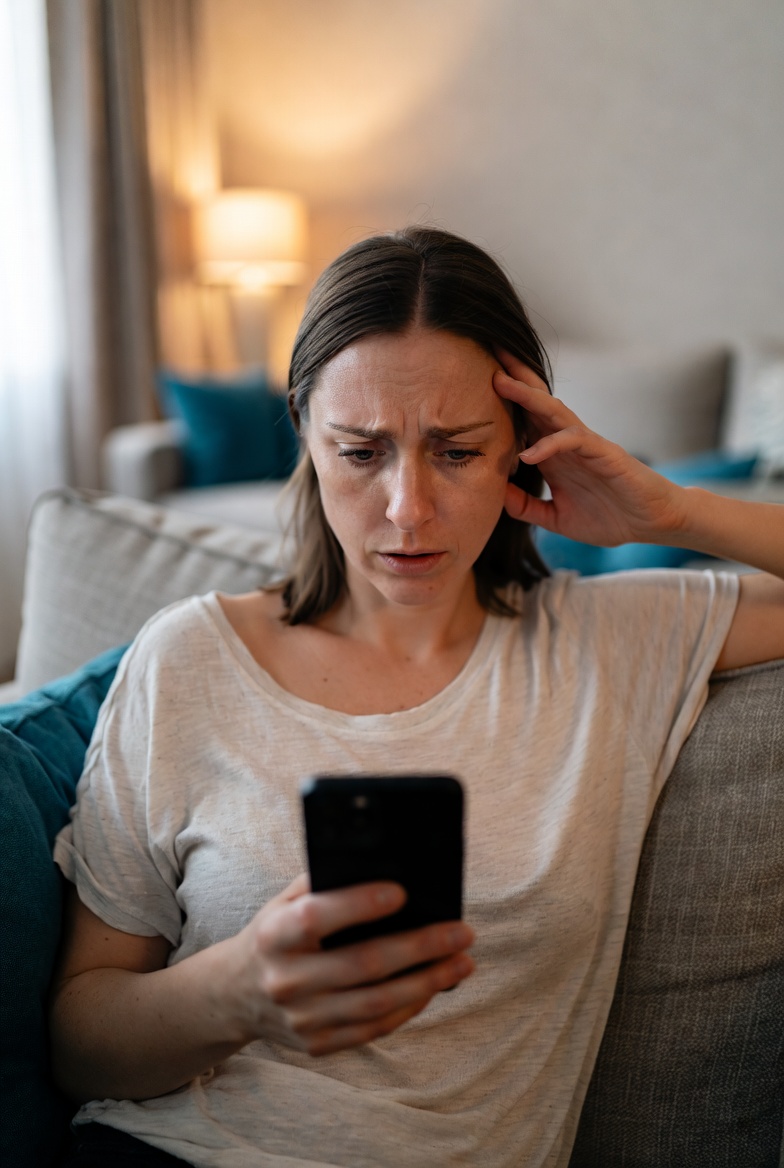
Rachel had been with her partner James for fourteen months when she finally admitted to herself that something was very wrong. Not with the relationship — with her. James was kind, communicative, consistent, and emotionally available in all the ways the relationship advice columns said to look for. He answered her texts. He made plans. He told her he loved her, often, without being asked. By every objective measure, the relationship was healthy.
And Rachel was utterly miserable.
She lived in a state of low-grade dread that was never far from spilling into full panic. The smallest delay in his replies could set her heart racing. A slightly off tone in his voice on the phone could trigger hours of internal interrogation: What did I do? Is he going off me? Is he about to leave? She had cried in school staff toilets between lessons because of a perfectly normal text exchange. She had drafted breakup messages at 2am and deleted them by morning. She had asked James "are we okay?" so many times that she had started rotating her phrasing so it didn't sound as obvious — "you'd tell me if anything was wrong, right?", "I just want to check in, how are we?", "I love you, do you still love me?" \u2014 each one delivered with an attempt at lightness that fooled neither of them.
Rachel was a Year Five teacher in Cardiff. She managed a classroom of thirty children, ran the school's literacy programme, and was widely considered competent and unflappable by the colleagues she worked with daily. Nobody at work would have guessed that she was, in her romantic life, ruled entirely by a fear that had no basis in reality and no off switch.
This is the contradiction at the heart of relationship anxiety: it is, almost by definition, the experience of suffering inside a relationship that is not actually in trouble. The relationship isn't the problem. The anxiety is.

From a difficult childhood to anxious adulthood
Rachel's relationship anxiety didn't appear overnight when she met James. It had been building, in various forms, since she was a teenager. The pattern was always the same: get close to someone, panic about losing them, behave in ways designed to keep them close, watch them eventually leave (often because of the panic-driven behaviour), and conclude that her fears had been right all along.
By the time she was 26, Rachel had been through three serious relationships and a string of shorter ones. Each had ended in a way that confirmed her worst fears \u2014 a partner pulling away, citing being "overwhelmed" or needing "space," eventually breaking up. From the outside, the pattern was clear: the anxiety was driving the outcomes she most feared. From the inside, she experienced each ending as proof that she was fundamentally unloveable, that her instincts were always right, and that the next relationship would inevitably go the same way.
The roots, when she eventually traced them with her therapist, went back further. Her parents had separated when she was seven. Her mother had been emotionally inconsistent in the years that followed \u2014 sometimes warm and present, sometimes withdrawn into her own depression. Rachel had learned, very young, to scan for emotional withdrawal, to anticipate it, to try to prevent it. The hypervigilance that made her a careful, observant child also made her a hypervigilant adult \u2014 always watching her partner for the first sign of leaving.
This is the textbook foundation of anxious attachment. The attachment style itself is not a character flaw. It is an adaptation that made sense in childhood. The trouble is that the same pattern, transferred onto an adult relationship with a partner who isn't going anywhere, becomes a source of constant suffering and, often, the destabilising force that creates the very abandonment it fears.
The loopThe hour that broke her each day
Rachel's relationship anxiety operated on a cycle so reliable she could have set her watch by it. The trigger was almost always something objectively small. James reading a message and not replying. James seeming a bit quiet over dinner. James spending a Saturday with his mates instead of suggesting they spend the day together. None of these things would warrant a second thought from a person without relationship anxiety. For Rachel, each one was a starter pistol.
The cycle ran roughly like this:
1. Trigger. James doesn't reply to a message for forty minutes during his work day. He'd previously been replying within ten minutes most days.
2. Catastrophic interpretation. The forty-minute silence is immediately read as evidence of withdrawal. He's going off me. He's been thinking about it for a while. He's working out how to end it. The interpretation feels not like a guess but like a certainty. Like she's seeing something true that other people would miss.
3. Physiological alarm. Heart rate up. Stomach tight. Difficulty concentrating. The body responding as though there is a real threat. Because to Rachel's nervous system, abandonment is a real threat \u2014 the same threat she learned to scan for as a seven-year-old.
4. Rumination. She replays the last conversation looking for what she might have done wrong. The last week. The last month. She finds things \u2014 a comment she made that he didn't laugh at, a moment when he seemed distracted, an evening when he was tired. Each item is treated as further evidence supporting Theory A: he's about to leave.
5. Safety behaviour. She drafts a follow-up message. She rewrites it three times to find the tone that's casual enough not to seem needy, but visible enough to nudge him to reply. She sends the message. She refreshes WhatsApp. She checks his "last seen." She considers calling him. She doesn't call him because she knows that would be too much.
6. Temporary relief. James replies. "Sorry, was on a call x". Relief floods through her. The relationship is, in fact, fine. She feels foolish. She feels grateful. She tells herself she'll never do that again.
7. Doubt returns. Within an hour, the next worry creeps in. His reply was shorter than usual. There was only one kiss. He didn't say "babe." That's a sign. The relationship is on borrowed time, and now he's annoyed at me too. Cycle restarts.
The cognitive distortions driving relationship anxiety
What makes relationship anxiety so disorientating is that it doesn't feel like anxiety in the moment. It feels like clear-eyed perception. Rachel didn't feel like she was catastrophising. She felt like she was seeing something true that healthier people were too naive to see. This is the trademark of a cognitive distortion: it disguises itself as accurate observation.
Several specific distortions were running her relationship:
Catastrophising
Every ambiguous signal was resolved at the worst end of its possible meaning. A delayed reply meant a breakup, not a busy meeting. A quieter evening meant withdrawal, not tiredness. The brain skipped past the ten most plausible explanations and landed on the most painful one. Read more about what catastrophising is and how to interrupt it.
Mind reading
Rachel was certain she knew what James was thinking, even when he had said nothing. "He's reconsidering." "He thinks I'm too much." "He's comparing me to his ex." She treated her assumptions about his internal state as facts. When asked to evaluate the evidence for any specific assumption, she rarely had any \u2014 only the strength of her own conviction, which she had been mistaking for proof.
Fortune telling
Predicting future relationship doom with absolute certainty. "This is going to end badly." "He's going to leave by Christmas." "We won't make it past the year mark." None of these predictions came with a basis. They came with a feeling \u2014 a feeling that fortune-telling, like all distortions, presents as foresight.
Emotional reasoning
"I feel anxious about the relationship, therefore the relationship must be in trouble." This is one of the most insidious distortions because it converts the anxiety itself into evidence for its own conclusions. The fact that Rachel was scared meant something must be wrong, which made her more scared, which felt like more evidence, and so on.
Black-and-white thinking
The relationship was either perfect or doomed. James was either fully present and adoring, or distant and about to leave. There was no middle ground for "James is having a normal Tuesday and is therefore slightly distracted." Real relationships exist almost entirely in the middle ground that black-and-white thinking refuses to acknowledge.
Discounting the positive
Years of consistent, loving behaviour from James were dismissed in seconds whenever the anxiety spiked. "Yes, but that was before. Yes, but he's been distant for a fortnight now. Yes, but maybe he's been forcing it." The positive evidence was always somehow rendered irrelevant by the anxiety, while the smallest negative signal was treated as definitive.
What didn't workThe strategies that made it worse
Like most people with relationship anxiety, Rachel had developed a number of coping strategies that felt like they were keeping the relationship safe but were actually keeping the anxiety alive. Each one provided short-term relief and long-term deterioration.
Constant reassurance-seeking
The most obvious one. Asking James whether he still loved her. Asking whether they were okay. Asking whether he was still attracted to her. Asking whether he ever thought about breaking up. Each ask brought genuine, immediate relief \u2014 sometimes lasting an hour, sometimes less. But each cycle taught her brain that she could not tolerate uncertainty about the relationship without external proof, raising the bar for what counted as proof and shortening the relief window. By the end, James was being asked the same questions multiple times a day, and his answers \u2014 always loving, always patient \u2014 were having less and less effect.
Social media surveillance
Checking who he'd liked on Instagram. Checking who he'd recently followed. Checking whether his ex had posted anything. Looking through the comments on his posts to see if any women were "being too friendly." This behaviour fed straight into the anxiety \u2014 there was always something ambiguous to find, some new detail to misinterpret, some innocent like to spend forty minutes ruminating about. The "information" she gathered didn't reduce uncertainty. It manufactured fresh material for the next spiral.
Pre-emptive breakups
This pattern is brutal and common in relationship anxiety. Rachel had, on three separate occasions during her relationship with James, told him she thought they should break up \u2014 not because she didn't love him, but because the unbearable uncertainty of waiting for him to leave had become worse than the imagined pain of leaving herself. She couldn't tolerate not knowing whether the relationship would survive, so she tried to control the outcome by ending it. Each time, James talked her down, and each time, she was secretly devastated that he had \u2014 because if he really loved her, he would have fought harder, wouldn't he? The bind has no exit if you're inside the anxiety.
Drinking before seeing him
If they had plans for dinner or to spend time together, Rachel often had a glass or two of wine before he arrived. The alcohol "took the edge off." It made her funnier, lighter, less hypervigilant about every word. Of course, it also impaired her judgement, made her quicker to start arguments she would regret, and meant she was developing an early association between needing alcohol and seeing the person she loved. She was 26. She was already drinking more than she meant to. She had not yet connected the two patterns.
Withdrawing as a test
Sometimes, when the anxiety was too much, Rachel would do the opposite of reassurance-seeking. She would go quiet. Send shorter messages. Cancel plans. The unconscious purpose was to see whether James would chase her \u2014 to see whether his pursuit would prove his love. He always did chase her. And yet the proof never landed, because she suspected he was just doing what he was supposed to do rather than really meaning it.
Rehearsing the breakup conversation
Lying awake at night, mentally rehearsing the conversation in which James told her he wanted to end things. Imagining what he would say. Drafting her own dignified responses. Working out which of her belongings were at his flat. This rumination felt like preparation \u2014 like she was getting ahead of an inevitability. It was actually pure rehearsal of imagined pain, training her nervous system to feel the loss in advance, so she experienced the breakup repeatedly even though it never happened.
Why these strategies feel rational: Each of Rachel's coping behaviours was a logical response to the belief that the relationship was about to end. If you really thought your partner was leaving, of course you would seek reassurance, monitor their social media, prepare yourself emotionally, and try to control the outcome. The behaviours weren't irrational given the belief. The belief was the problem \u2014 and that's what treatment had to address.
The argument that broke the pattern
The turning point for Rachel didn't come from a therapy book or a moment of insight. It came from an argument. The third pre-emptive breakup attempt. James had finally lost his patience.
"You keep doing this, Rachel. You keep telling me we should break up because you're scared we will. And every time, I have to convince you we're fine. I love you. I'm not going anywhere. But I cannot keep proving it to you every week. You're going to make this happen if you don't stop. Not because I want to leave \u2014 because there's nothing left of me to give to convincing you to stay."
It wasn't a threat. He wasn't ending it. But it was the first time he had named the dynamic out loud, and the first time Rachel had been forced to hear that her behaviour had a real cost \u2014 that the very thing she was doing to protect the relationship was the thing destabilising it. She booked an appointment with her GP the next morning.
The GP listened, asked a few questions, and used a phrase Rachel had never heard before: "anxious attachment." She explained that what Rachel was describing was a recognisable, treatable pattern, and referred her to NHS Talking Therapies (formerly IAPT) for cognitive behavioural therapy. While the referral processed, she suggested guided self-help resources to start with.
The relief Rachel felt at being told her experience had a name was, in itself, therapeutic. It moved the problem out of "I am fundamentally broken at love" and into "I have a treatable anxiety pattern that's affecting my relationship." Those are two completely different problems with completely different prognoses.
How Rachel broke the loop
What follows are the specific techniques Rachel used over the fourteen weeks of her recovery. They were drawn from CBT and ACT, the two evidence-based approaches with the strongest track record for anxiety presentations of this kind. None of them are quick fixes. All of them required practice, often daily, often when she least felt like it. The change came from the cumulative weight of small efforts, not from any single breakthrough.
1 Response prevention for reassurance-seeking
This was the foundational change. Rachel stopped asking James for reassurance \u2014 not gradually, not partially, fully. The first week was extraordinarily difficult. The urge to ask "are we okay?" arose dozens of times a day, and each time she resisted, the anxiety spiked. But each time she sat with the discomfort and didn't act on it, the anxiety eventually subsided on its own \u2014 usually within twenty to forty minutes. This taught her brain that uncertainty was tolerable, that she didn't need an answer to be okay, and that the urge to seek reassurance was not, in fact, the same as needing reassurance.
2 Removing surveillance triggers
Rachel deleted Instagram from her phone for the duration of her recovery. She also turned off WhatsApp "last seen" and read receipts on her own account, so she stopped knowing exactly when he had read her messages. The point wasn't to hide from information \u2014 it was to stop feeding the anxiety with material to misinterpret. After about four weeks she reinstalled Instagram with strict use limits. After eight weeks she barely thought about checking his profile.
3 Thought records
Whenever the anxiety spiked, Rachel wrote it down. Not the whole spiral \u2014 just three columns. Trigger ("James didn't reply for an hour"). Automatic thought ("He's losing interest"). Evidence for and against, balanced view. The exercise was deliberately mechanical. The point wasn't to make her feel better in the moment. The point was to build a written record of how often the anxiety predicted things that didn't happen \u2014 a record her anxious brain couldn't dismiss as easily as it could dismiss a single reassuring thought.
4 Behavioural experiments
Rachel and her therapist designed specific tests of her predictions. Prediction: if I don't text James for the whole working day, he'll think I've gone off him and become distant. Test: don't text him for the whole working day. Outcome: he sent her a "hope your day's going well x" message at lunchtime, and was the same as ever when she got home. Each experiment provided concrete real-world evidence that her predictions were systematically wrong. Over weeks, the cumulative weight of disconfirmed predictions started to weaken the anxiety's authority.
5 Cognitive defusion (ACT)
Instead of arguing with the anxious thoughts (which kept her engaged with them), Rachel learned to observe them. "I'm having the thought that he's going to leave me." "I'm noticing the urge to text him." This ACT technique doesn't try to eliminate the thoughts or prove them wrong. It changes the relationship to them \u2014 from "this is true" to "this is a thought my brain is producing." The thoughts lost their grip not because Rachel argued them down, but because she stopped treating them as commands.
6 Distinguishing intuition from anxiety
One of Rachel's most insistent fears was that she was missing real warning signs by treating everything as anxiety. What if her instincts were right and she was being convinced to ignore them? Her therapist taught her a specific distinction: real intuition is calm, specific, and consistent over time. Anxiety is loud, generalised, and intensifies under stress. If a "gut feeling" disappears when she's calm and reappears when she's anxious, it's anxiety wearing intuition's clothing. If it persists across moods and sleeps, it might be worth listening to. Rachel's "feelings" about James never survived a calm Sunday morning. That was its own data.
7 Sitting with uncertainty (the core ACT skill)
The hardest and most transformative skill. Relationship anxiety demands certainty: "I need to know we're going to be okay." But certainty about another person, or about the future, is impossible. Nobody can guarantee a relationship will last. Rachel had to learn to live with "I don't know for sure, and I am willing to love this person anyway." This isn't resignation \u2014 it's the foundation of every adult relationship. Most people get there without thinking. People with relationship anxiety have to learn it deliberately, through hundreds of small moments of choosing love over certainty.
8 Values-based action
Rather than waiting for the anxiety to disappear before acting like a partner she could be proud of, Rachel identified her values \u2014 trust, generosity, presence, kindness \u2014 and committed to acting from them even when she didn't feel them. When she felt the urge to send a passive-aggressive message, she asked: "What would the partner I want to be do here?" Often the answer was "send a kind message instead, or send no message at all." Acting from values rather than from anxiety was uncomfortable at first and increasingly natural over time.
9 Telling James once, properly
Rachel told James everything \u2014 the diagnosis, the techniques, what helped (her doing the work), what didn't (him providing reassurance on demand). She asked him to gently redirect her if she fell back into reassurance-seeking. "I love you, but I'm not going to keep answering this question \u2014 you know the answer, and the answer is yes." This single conversation, done once, was infinitely more useful than the hundreds of micro-conversations of the previous year. Most importantly, she did not return to the well to renegotiate it weekly.
10 Stop The Loop for the urgent moments
The acute moments \u2014 the spike at 11pm when James hadn't replied to her good-night message, the sudden conviction during a Sunday lunch that he was bored of her, the 3am wake-up convinced something was wrong \u2014 were when the urge to seek reassurance was strongest. In those moments, Rachel used the app's emergency spiral mode. The AI guided her through grounding, identified the cognitive distortion she was running, and reminded her of the specific evidence she'd recorded against the anxious prediction. It functioned as an external scaffolding for the techniques while they were still becoming automatic.
The Saturday that proved it had worked
Eight weeks into her recovery, Rachel and James had a misunderstanding. He had said something that hurt her feelings. The conversation had ended without complete resolution. He'd gone to play football with friends. She had a whole afternoon alone in their flat with the unresolved tension still hanging in the air.
In the old pattern, she would have spent that afternoon spiralling. She would have texted him a series of messages of escalating anxiety. She would have probably called. She would have rehearsed apologies and demanded conversations. By the time he came home she would have worked herself into a state of certainty that the misunderstanding was the beginning of the end.
Instead, she went for a walk. She came back. She read for an hour. She made dinner. The anxiety arose multiple times \u2014 the urge to text him, the catastrophic interpretations, the certainty that this was the moment everything fell apart. Each time, she noticed it, named it, didn't act on it. By the time James came home, sweaty and apologetic and ready to talk it through properly, the misunderstanding was just a misunderstanding. They resolved it in fifteen minutes.
What made this a breakthrough wasn't the outcome. It was the process. For the first time in her adult life, Rachel had experienced relationship friction without converting it into relationship catastrophe. She had tolerated the uncertainty. She had trusted James to come back. The relationship had survived because she had finally stopped trying to save it.
Where Rachel is nowFourteen weeks later
Rachel has not asked James a reassurance question in over two months. The relationship is stable. They got engaged six weeks after she finished her course of CBT \u2014 not as a grand gesture, but in the quiet, ordinary way that suited them both. She is sleeping better. Her drinking has reduced significantly. Her phone is no longer the central organising device of her emotional life.
The anxiety has not been eliminated. The thoughts still appear \u2014 a flicker of catastrophising when he's late home, a moment of mind reading when he seems quiet. The difference is in her response. She notices the thought. She names the distortion. She doesn't act on it. It passes within minutes, often within seconds. Where the anxiety used to control her behaviour, she now observes it as a familiar but uninteresting feature of her brain \u2014 like a weather pattern, not a command.
Most importantly, the change in her behaviour has changed the texture of the relationship itself. James is more relaxed because he isn't constantly being asked to prove his love. The conversations are warmer because they aren't laced with anxiety. The intimacy is deeper because it's no longer mediated by her constant scanning. The relationship she was so terrified of losing has, paradoxically, only become really hers since she stopped trying to hold onto it so tightly.
She still uses the techniques. Thought records when she catches herself spiralling. Grounding when an acute moment hits. The app's structured sessions when she needs to process a particularly bad day. Recovery is not a destination she has arrived at. It's a practice she keeps, daily, because the loop is always available to fall back into and she never wants to live there again.
If your partner has relationship anxiety
This case study has focused on Rachel. But for every person living with relationship anxiety, there is a partner trying to figure out how to help \u2014 and often making the situation worse with the best of intentions. If you are James, the following might be useful:
Reassurance is not the answer. The instinct, when someone you love asks "are you sure you still love me?" is to say "yes, of course, definitely." This is a kind, loving response. It also functions as a compulsion-reinforcer for someone with relationship anxiety, training their brain to need the next reassurance, sooner. The most loving response, once you understand the pattern, is "I love you, and I'm not going to keep answering that question \u2014 you know the answer."
You are not responsible for fixing it. Relationship anxiety is a clinical pattern that responds to professional treatment. You cannot love it out of someone, no matter how patient you are. Your job is to be a steady, consistent partner. Their job is to do the work of treatment.
Set limits without setting ultimatums. "I love you, and I cannot keep being the source of reassurance \u2014 it's not helping you and it's wearing me out. I need you to get support for this." Said early, kindly, and clearly, this is one of the most useful things a partner can do.
Don't take the spirals personally. When your partner spirals, they are not actually doubting you. They are experiencing a symptom of an anxiety pattern. The content (you, the relationship) is incidental \u2014 if you weren't there, the anxiety would attach to whoever was. This doesn't mean you have to absorb it. It means you don't have to defend yourself against it.
Look after yourself. Loving someone with untreated relationship anxiety is exhausting. You are allowed to find it hard. You are allowed to need your own support. There are no medals for absorbing it silently.
Key takeawaysWhat Rachel's story teaches us
Relationship anxiety attaches to whoever you love. If the doubt would follow you into your next relationship and the one after that, it's not about this partner. It's about a pattern in you that needs treatment.
Reassurance is the compulsion, not the cure. Each ask provides relief. Each ask makes the next ask more necessary. Treating reassurance-seeking like the OCD compulsion it functionally is, and stopping it through response prevention, is one of the most effective single changes you can make.
The anxiety is not protecting your relationship. It is destabilising it. The very behaviours that feel like care \u2014 the constant checking, the questions, the surveillance, the pre-emptive breakups \u2014 are the thing most likely to make the feared outcome happen.
You cannot think your way out of this. Many people with relationship anxiety can describe their pattern with clinical precision. Knowledge of the pattern is not the same as treatment of the pattern. The change happens through practice, not insight.
Recovery is not the absence of anxiety. It is the absence of anxiety running your life. The thoughts may keep appearing. What changes is your relationship to them \u2014 from commands you must obey to noise you can notice and let pass.
Your partner cannot heal you. No amount of love, patience, or reassurance from another person can substitute for the internal work. This is good news. It means the recovery is in your hands.