A successful career, a happy life \u2014 and a secret
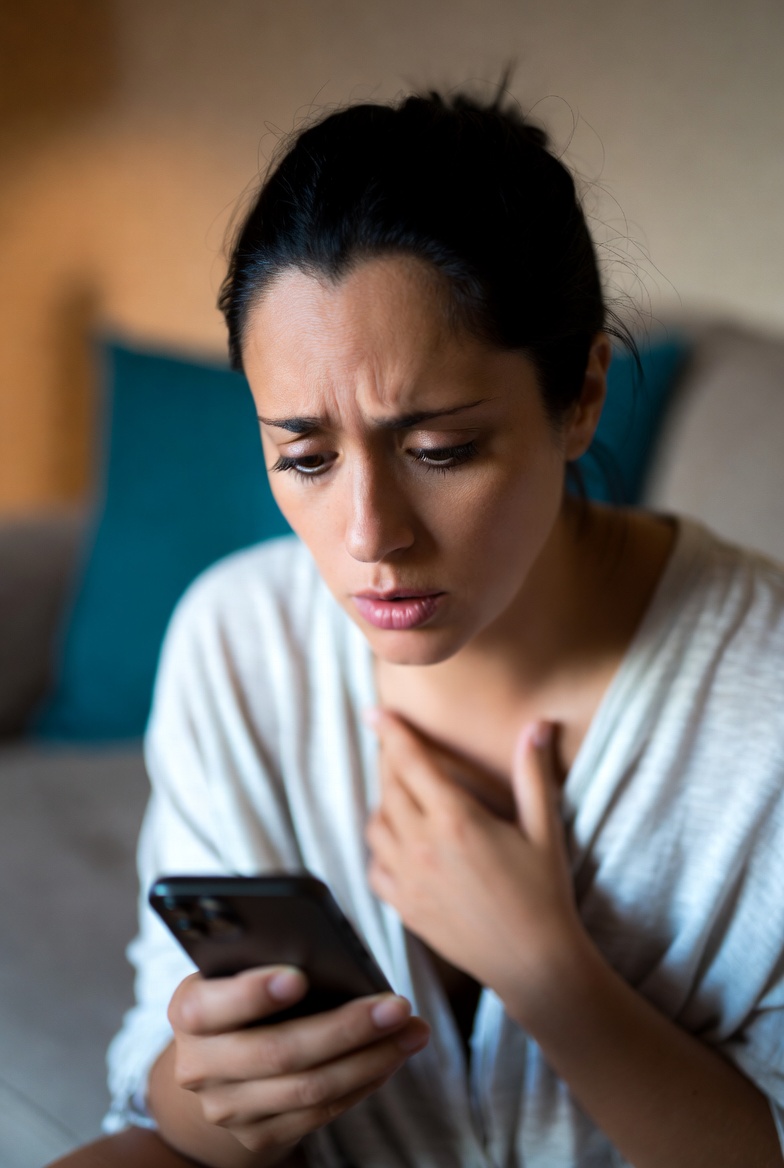
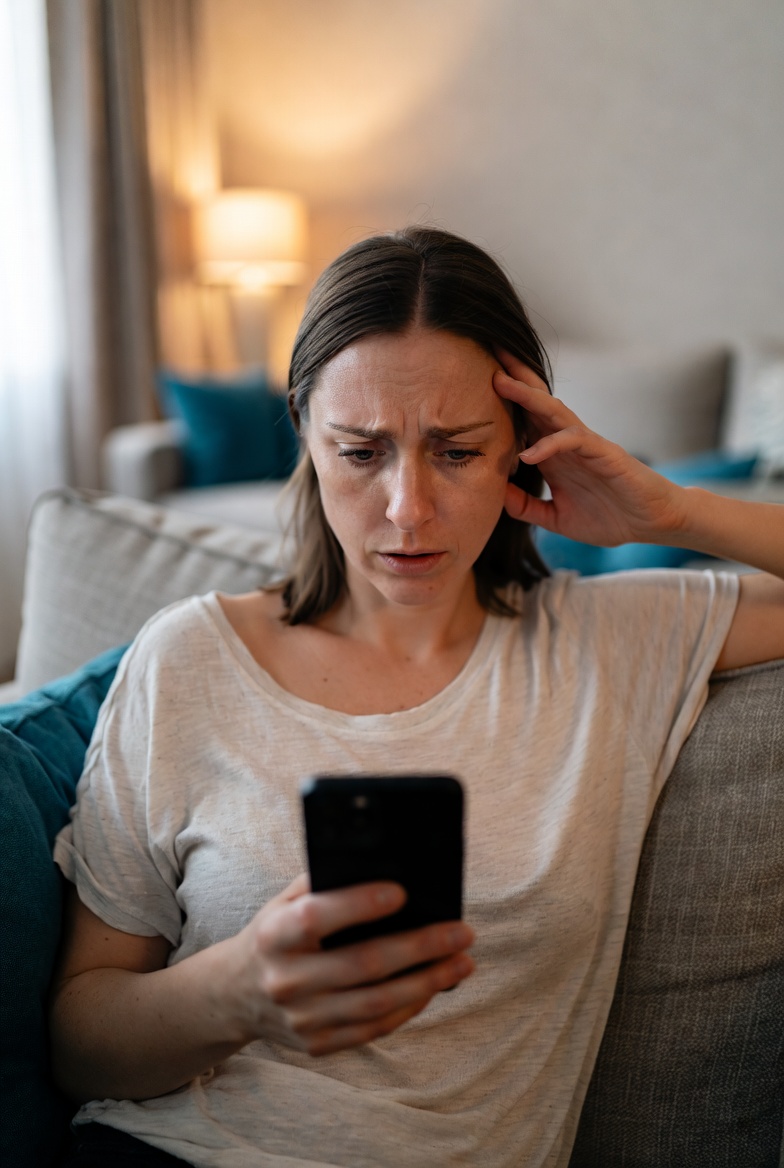
On paper, Sarah had everything under control. She managed a team of twelve at a Bristol marketing agency, owned a flat with her partner, and maintained a busy social life. Nobody at work knew that she spent up to three hours every evening Googling symptoms. Nobody knew that she'd visited her GP fourteen times in the past year. Nobody knew that she'd secretly paid for private MRI scans, blood panels, and cardiac tests \u2014 all of which came back normal. Nobody knew that the confident, composed marketing manager they saw by day was, by night, lying in bed checking her pulse against the carotid artery, convinced she could feel an arrhythmia.
Sarah's health anxiety had started four years earlier, after a colleague was diagnosed with bowel cancer at age 32. The diagnosis was a shock \u2014 her colleague was young, fit, and showed no obvious signs of illness. For Sarah, this shattered the assumption that serious illness only happens to other people, to older people, to people who don't take care of themselves. If it could happen to her colleague, it could happen to anyone. It could happen to her.
Within weeks of her colleague's diagnosis, Sarah noticed a stomach cramp after lunch. Normally she'd have ignored it. This time, her brain made the connection: stomach cramp \u2192 bowel cancer. The thought was electric. Her heart raced. She felt sick. She couldn't concentrate for the rest of the afternoon. That evening, she Googled "stomach cramp bowel cancer" and spent two hours reading medical forums. By midnight, she was convinced she had symptoms she hadn't noticed before. The loop had begun.
What Sarah didn't yet have was a name for it. She assumed, as most people do in the early stages, that she was just being "sensible" about her health \u2014 cautious, responsible, thorough. It would take four years, one excellent CBT therapist, and a specific framework called Theory A versus Theory B for her to realise that what she had was a recognised clinical condition with a long history, a clear mechanism, and effective evidence-based treatment: health anxiety.
From hypochondria to Illness Anxiety Disorder
Health anxiety has been called many things over the years. The older term was hypochondria, which carries unfortunate connotations and is rarely used clinically anymore. In the current edition of the diagnostic manual (DSM-5), the condition is classified as Illness Anxiety Disorder (for people who worry about health despite few or no actual symptoms) or Somatic Symptom Disorder (where the worry is attached to genuine physical symptoms). In the UK, NHS services and most UK therapists simply call it "health anxiety." It affects roughly 3\u20135% of UK adults at any given time \u2014 well over a million people \u2014 and is significantly more common than any of the serious illnesses most health-anxious people fear they have.
Health anxiety is characterised by four core features that distinguish it from ordinary health concern:
- Disproportionate worry about having or developing a serious illness
- Excessive health-related behaviours such as body-checking, symptom-searching, repeated medical consultations, or in some presentations complete avoidance of doctors
- Inability to accept reassurance from medical professionals \u2014 normal test results provide relief that fades rapidly
- Significant interference with daily life \u2014 hours per day lost to health-related worry and behaviours
Sarah met every one of these criteria by any reasonable clinical assessment. She had been meeting them for four years. She had not been diagnosed, because she had not named what was happening as a mental health condition requiring treatment. She had treated it, instead, as a sensible ongoing search for the illness she was sure she had.
Cyberchondria \u2014 a modern twist: The specific pattern of escalating health anxiety through compulsive online symptom-searching has been given its own name in the research literature: cyberchondria. It isn't a separate diagnosis. It is a behavioural pattern strongly associated with health anxiety, and it is now part of most modern presentations. The internet delivers the exact worst-case information an anxious brain is looking for, at 2am, for free, without a waiting room. Cyberchondria makes health anxiety faster, more accessible, and harder to escape than it was twenty years ago.
How health anxiety maintained itself
Sarah's anxiety operated on a cycle so precise it could have been programmed. It went like this, every single day, often multiple times per day:
Step 1: Notice a sensation. A headache. A twinge in her side. A palpitation. A muscle that twitched. These are sensations that every human body produces constantly \u2014 most people don't notice them. Sarah's brain, now hypervigilant after four years of scanning, noticed every single one.
Step 2: Catastrophise. The sensation was immediately interpreted through the lens of the worst possible explanation. A headache wasn't dehydration or tension \u2014 it was a brain tumour. A stomach cramp wasn't the burrito she'd had for lunch \u2014 it was bowel cancer. A palpitation wasn't the double espresso she'd just finished \u2014 it was a heart arrhythmia. Her brain skipped past the ten most likely explanations and landed on the most terrifying one.
Step 3: Anxiety response. The catastrophic interpretation triggered genuine anxiety. Heart racing, breathing changes, nausea, dizziness, muscle tension. Here's the cruel irony: these anxiety symptoms are physical. Sarah's brain then interpreted these anxiety symptoms as further evidence of illness. The racing heart became "something's wrong with my heart." The nausea became "something's wrong with my stomach." The dizziness became "something's wrong with my brain." The anxiety was producing the very symptoms it was catastrophising about.
Step 4: Check. Google. Self-examine in the mirror. Press on the area that hurt. Ask her partner, "Does this look normal to you?" Read medical forums. Compare her symptoms to descriptions of serious illnesses. Check her pulse. Check her temperature. Check, check, check.
Step 5: Temporary relief. A benign Google result. Her partner's reassurance. A normal temperature reading. For a few minutes \u2014 sometimes a few hours \u2014 the anxiety would reduce. Sarah would think: "I'm fine. I'm being ridiculous. I need to stop this."
Step 6: Doubt returns. "But what if Google was wrong? What if my partner was just saying what I wanted to hear? What if the GP missed something? What if THIS time it's real?" The cycle would restart, often within the same evening. Often about the same symptom. Sometimes about a new one.
The cognitive distortions driving health anxiety
All anxiety presentations are driven by specific cognitive distortions. Health anxiety has a characteristic signature \u2014 the same five or six distortions running in almost everyone who has it. Naming them is the first step in dismantling them.
Catastrophising
The core distortion in health anxiety. Every sensation is interpreted at the worst end of its possible meaning. A headache skips past "dehydration," "tension," "tiredness," "eye strain," "hunger," and "the start of a cold" and lands directly on "brain tumour." The brain is not running through the probability distribution; it is jumping to the most catastrophic point on the curve. Importantly, catastrophising is not the same as being cautious. Caution considers likelihood. Catastrophising ignores it.
Emotional reasoning
"I feel scared, therefore something must be genuinely wrong." This treats the feeling of fear as evidence of actual danger. In reality, fear is a signal about how your brain is interpreting a situation \u2014 not a signal about the situation itself. Health anxiety relies heavily on emotional reasoning because it lets the feeling of anxiety function as "proof" that the illness must be real. Without this fusion, the anxiety would lose most of its apparent authority.
Mental filtering
Paying attention only to information that confirms illness while dismissing the information that contradicts it. Sarah had received, over four years, approximately forty normal test results, fourteen GP reassurances, multiple private scan confirmations, and countless calm weeks where her body did nothing alarming. The single abnormal-feeling moment got full weight; the forty normal results got none. Mental filtering is how the evidence base is kept, artificially, always on the side of illness.
Intolerance of uncertainty
The demand for absolute certainty about health \u2014 a demand that cannot be met by medicine, by testing, or by any human experience. Reasonable monitoring accepts "probably fine, keep an eye on it." Health anxiety accepts nothing less than "definitely fine, guaranteed, forever." Since that certainty does not exist, no amount of testing ever resolves the anxiety for long. This is why each normal result produces only brief relief.
Hypervigilance and attention bias
The brain of a health-anxious person becomes attentionally tuned to physical sensations. Where a non-anxious person would miss a twinge entirely, the health-anxious person notices it immediately and puts it centre stage. Over months and years of this, the brain becomes better and better at finding sensations to worry about. The irony is that noticing more sensations doesn't mean you have more sensations \u2014 it means you're processing them differently. Everyone's body is doing roughly the same things; only the attention changes.
Thought-outcome fusion
A variant of the OCD pattern, also seen in health anxiety. The belief that thinking about a serious illness makes it more likely, or that having the thought is itself a signal. "I keep thinking about cancer, so it must be because something is actually there." In reality, intrusive thoughts about illness are produced by the anxious pattern itself, not by any underlying physical signal. Your brain is not giving you a medical warning. It is running a maladaptive loop.
What didn't workThe things that made it worse
Googling symptoms
This was Sarah's primary compulsion, and it was devastating. Medical information online is designed for clinicians \u2014 it lists every possible cause of every symptom, including rare and serious conditions. For Sarah, every search confirmed her worst fear. Even when she found benign explanations, the relief lasted minutes before her brain found a reason to doubt it. Research suggests that roughly 75% of health-anxious individuals experience increased anxiety after symptom-searching, even when the search was intended to provide reassurance.
Repeated GP visits
Sarah's GP was patient and thorough. She ran tests. She examined Sarah. She provided reassurance. But each reassurance became a fix that wore off faster than the last. Sarah needed to hear "you're fine" more frequently, from more sources, with more tests to back it up. The GP visits were maintaining the anxiety, not curing it \u2014 because they taught Sarah's brain that external validation was required to feel safe. Her GP, to her immense credit, eventually recognised the pattern and gently suggested a different approach.
Private medical tests
Sarah spent over \u00a34,000 on private scans and blood tests over three years. Every result was normal. And every normal result provided approximately 48 hours of relief before the doubt crept back: "What if the scan missed something? What if it's too early to detect? What if I need a different type of scan?" The tests were the most expensive form of reassurance-seeking, and they were no more effective than a Google search. Health anxiety, left unchecked, can be genuinely financially ruinous \u2014 a hidden cost that partners and families often don't see until the credit-card statements arrive.
Avoiding health information entirely
At one point, Sarah tried the opposite approach \u2014 avoiding all health-related content. She stopped Googling, stopped watching medical dramas, stopped reading health articles. This worked for about a week. Then, deprived of her usual checking behaviour, the anxiety intensified until she caved. Avoidance without replacement skills doesn't work \u2014 it just builds pressure until the compulsion returns with more force.
Asking her partner for reassurance
Her partner, trying to help, had been providing reassurance for years. "Does this look okay?" "Yes love, it looks okay." "Are you sure?" "Yes, I'm sure." Every such exchange gave Sarah a few minutes of relief. Every such exchange also taught her brain that her partner's voice was required for her to tolerate uncertainty. Her partner had become, unknowingly, part of the compulsion network. His kindness was feeding the cycle. This is one of the most common patterns in long-term health anxiety \u2014 the quiet involvement of the person who loves you most.
Waiting for it to pass
Sarah spent two of the four years telling herself that the health anxiety would probably "just go away" once a particular stressor resolved \u2014 the work project finished, the family situation settled, her cousin recovered from her own illness. It didn't go away. Untreated health anxiety, for most people, does not fade on its own; it consolidates. The pattern becomes increasingly automatic the longer it runs. Waiting, in Sarah's case, had cost her three more years than getting help earlier would have.
The turning pointTheory A vs Theory B
Sarah's turning point came when she started working with a CBT approach \u2014 initially through guided self-help, then with a therapist who specialised in health anxiety. The first substantive exercise changed everything. It was called Theory A vs Theory B, and it is one of the most powerful interventions for health anxiety in the CBT literature.
Theory A (the health anxiety belief): "I have a serious illness that hasn't been detected yet."
Theory B (the alternative explanation): "I have health anxiety, which produces the thoughts, feelings, and physical symptoms I am experiencing."
The exercise asked Sarah to evaluate the evidence for each theory. For Theory A: fourteen GP visits, multiple blood tests, an MRI, a cardiac scan, an endoscopy \u2014 all normal. No progressive deterioration. No objective signs of illness found by any medical professional in four years. For Theory B: constant worry about health, compulsive checking behaviours, temporary relief from reassurance that never lasts, anxiety symptoms that mimic the illnesses she fears, a clear trigger event (her colleague's diagnosis), and a pattern that had consolidated over years in exactly the way health anxiety consolidates.
The evidence overwhelmingly supported Theory B. Sarah didn't have an undetected illness. She had health anxiety. And health anxiety \u2014 unlike the diseases she feared \u2014 was treatable.
What made the exercise powerful wasn't the conclusion. Sarah had intellectually known she probably had health anxiety for a while. What made it powerful was structuring the evidence formally, on paper, in a way her anxious brain couldn't explain away in the moment. The evidence pool for Theory A was genuinely empty after four years of searching. The evidence pool for Theory B was overwhelming. She couldn't unsee that once she had seen it.
How Sarah broke the loop
Over the next twelve weeks, Sarah worked weekly with her CBT therapist and daily on her own. The techniques below are drawn from that combined work. They are deliberately concrete. Health anxiety doesn't respond to insight alone \u2014 it responds to structured behavioural and cognitive change practised consistently.
1 Theory A vs Theory B \u2014 revisited regularly
Not a one-off exercise. Sarah revisited the comparison every time the anxiety spiked. New symptom? Which theory does the evidence actually support? The written version \u2014 kept in a notebook, later in her phone \u2014 became a reference she could return to when her brain was trying to convince her that this time it was different. The short answer was always: no, it isn't. This is still Theory B.
2 Dropping safety behaviours gradually
Sarah's checking behaviours \u2014 Googling, body-scanning, asking her partner, pulse-checking \u2014 were maintaining the anxiety. But she couldn't stop them all at once (that would be overwhelming). Instead, she worked with a graded approach. Week 1: reduce Google symptom-searching from 3 hours to 1 hour. Week 2: reduce to 30 minutes. Week 3: reduce to 10 minutes. Week 4: stop entirely. Each reduction felt uncomfortable \u2014 the urge to check was intense \u2014 but each time she resisted, the anxiety peaked and then subsided on its own. Her brain was learning that uncertainty was tolerable.
3 Cognitive defusion for health thoughts
Instead of arguing with her health-anxious thoughts (which kept her engaged with them), Sarah learned to observe them. "I'm noticing the thought that this headache is a brain tumour." She didn't fight the thought or try to disprove it. She just noticed it, the way you might notice a car passing on the road. The thought lost its power not because it was proven wrong, but because Sarah stopped treating it as an emergency requiring immediate action. This is an ACT technique, and it works particularly well for health anxiety because it removes the fuel \u2014 engagement \u2014 that the thoughts depend on.
4 Attention training outward
Sarah's brain had become hyper-focused on internal sensations \u2014 constantly scanning her body for symptoms. Attention training involved deliberately redirecting her focus outward. When she caught herself body-scanning, she would engage with something external: a detailed task at work, a conversation, a podcast, a walk where she focused on what she could see and hear. Over time, the automatic body-scanning habit weakened. This doesn't happen quickly \u2014 the brain has to be retrained through repetition \u2014 but it does happen.
5 Identifying and naming the distortions
Sarah learned to name the specific thinking errors her brain was making. Catastrophising (jumping to the worst diagnosis). Emotional reasoning ("I feel scared, so something must be wrong"). Mental filtering (focusing only on the one symptom while ignoring the twenty normal test results). Fortune telling ("I just know this is going to be bad"). Naming the distortion was surprisingly powerful \u2014 it moved the thought from "this is truth" to "this is a pattern my brain runs." Once you can name the pattern, you're half a step outside it.
6 Sitting with uncertainty as an explicit skill
The hardest technique and the most transformative. Health anxiety demands certainty: "I need to KNOW I'm not ill." But certainty about health is impossible \u2014 no amount of testing can guarantee you'll never get sick. Sarah had to learn to live with "I don't know for certain, and that's okay." This didn't happen overnight. It happened through hundreds of small moments where she felt the urge to check, didn't check, survived the discomfort, and slowly built evidence that uncertainty was bearable. Uncertainty tolerance is a skill, not a feeling. It gets better with practice.
7 Structured check-in system with the GP
Rather than going to the GP fourteen times a year, Sarah and her GP agreed a framework. She would see the GP once every six months for a general check-in, and any new symptom lasting more than two weeks. Random minor sensations \u2014 the majority of what had been driving her visits \u2014 would not warrant appointments. This formalised a reasonable level of medical contact and removed the decision-making (and anxiety) from each individual moment. The GP did not abandon her. The GP stopped unwittingly participating in the compulsion.
8 Asking her partner to stop providing reassurance
Sarah and her partner, with the therapist's guidance, agreed specific scripts. When Sarah asked "does this look normal?" her partner would reply "we agreed I wouldn't answer that" or "that's your health anxiety asking, not you." It felt cruel in the first week \u2014 Sarah experienced the withdrawal of reassurance as abandonment. By week three, she was rarely asking. By week six, she wasn't asking at all. Her partner's kindness had been feeding the cycle for years; its removal was one of the most loving things he did.
9 Behavioural experiments with sensations
Specific predictions, tested. Prediction: if I notice a headache and don't Google, don't take paracetamol immediately, and don't tell my partner, I will be in severe pain for hours and I won't be able to cope. Test: notice a headache, don't Google, sit with it. Outcome: the headache resolved on its own within an hour. Her prediction was wrong. Accumulated over weeks, these experiments produced concrete evidence that her brain's catastrophic predictions were consistently incorrect. Each experiment was a small proof.
10 Stop The Loop's emergency mode for the acute moments
When the checking urge was overwhelming \u2014 particularly late at night, when her partner was asleep and Google was one tap away \u2014 Sarah used the app's emergency spiral mode. Instead of Googling (which feeds the loop), she opened the app. The AI asked what she was experiencing, identified the health anxiety pattern, and guided her through defusion and grounding techniques. It wasn't reassurance. It was skill-building. And critically, it was available at 11pm when no therapist would be. She still uses the mood-tracking feature because it shows her when the pattern is creeping back during stressful weeks \u2014 an early warning system for relapse.
The headache that changed everything
Eight weeks into her recovery, Sarah developed a headache. A real, persistent headache that lasted three days. In the old pattern, this would have triggered immediate catastrophising, hours of Googling, and possibly a GP visit.
Instead, Sarah noticed the thought: "I'm having the thought that this could be something serious." She didn't engage with it. She didn't Google. She didn't check. She took paracetamol, drank water, and carried on with her day. The headache passed on day three \u2014 it was tension from a stressful week at work.
What made this moment a breakthrough wasn't the outcome. It was the process. For the first time in four years, Sarah had experienced a physical symptom, noticed the anxious thought, and not acted on it. She had tolerated the uncertainty. She had trusted her body. The loop had been broken.
Twelve weeks later, and one year on
Sarah's daily Google time went from approximately 3 hours to under 10 minutes \u2014 and the 10 minutes is intentional health information seeking (checking NHS guidance on a cold, for example), not compulsive symptom-searching. She hasn't visited her GP for a health anxiety-driven concern in three months. She cancelled her standing order for private blood tests and put the saved money toward a proper holiday.
The health-anxious thoughts still appear \u2014 they probably always will. The amygdala doesn't forget its patterns. But Sarah's relationship with those thoughts has fundamentally changed. She notices them, names the distortion, and redirects her attention. Most days, this takes seconds. On bad days, she uses guided sessions to work through it.
A year on from her worst point, Sarah has reclaimed her evenings. The three hours she used to spend Googling are now spent reading, cooking, exercising, and being present with her partner. She has started mentoring a junior colleague who recently confided that she has been having similar experiences. She has also, importantly, seen her GP once in that year for a legitimate chest infection \u2014 without it becoming a full spiral. This is what recovery looks like. Not the absence of ever worrying about health. The restoration of normal, proportionate, occasional worry in place of a round-the-clock loop.
If someone you love has health anxiety
Living with a partner or family member who has health anxiety is its own kind of exhausting. The checking, the repeated questions, the Googling at 1am, the tests that produce relief for 48 hours before the cycle restarts \u2014 it wears down the people around the person, often silently. A few things are worth saying directly.
Learn what health anxiety actually is. Anxiety UK, Mind, and No More Panic all have resources specifically for families and partners. Understanding that the pattern is a recognised clinical condition (not irrationality, not manipulation, not attention-seeking) changes everything about how useful your support can be.
Stop providing reassurance, but do it carefully. Reassurance feels like love. For someone with health anxiety, repeated reassurance is feeding the cycle. Withdrawal of reassurance should be done during treatment, ideally with therapist guidance, not as a unilateral decision. Specific phrases agreed in advance work best: "we agreed I wouldn't answer that" or "that sounds like the health anxiety talking." The goal is not to abandon them. The goal is to stop participating in the compulsion.
Do not search symptoms together. "Let me just have a quick look with you" turns two people into the compulsion. Politely decline. They can look if they choose; you do not have to be part of it.
Encourage treatment, not just discussion. Discussing the anxiety endlessly is a form of reassurance-seeking. Getting actual help \u2014 a GP appointment, a self-referral to NHS Talking Therapies, a private CBT therapist \u2014 is what produces change. If you can help remove the friction from accessing treatment (making an appointment, accompanying them the first time, being supportive of therapy homework), that is practical love.
Look after your own wellbeing. Being the partner of someone with health anxiety is its own emotional burden. You are allowed to find it hard. You are allowed to need support. Your exhaustion is not disloyalty.
For GPs and primary care cliniciansA quiet note on the GP-patient dynamic
Sarah's GP did an enormous amount of right things. She listened. She examined. She ordered sensible tests. She provided reassurance thoroughly and repeatedly. And for four years, none of it helped, because reassurance is the thing that maintains health anxiety rather than resolving it.
There is a quiet, underrecognised challenge in UK primary care: the GP who is trying to be thorough and kind can, without anyone doing anything wrong, be unwittingly participating in the maintenance of a clinical condition. A few things \u2014 if you are a clinician reading this \u2014 that the literature suggests help:
Screen proactively for health anxiety in patients with frequent presentations. Any patient presenting 10+ times per year for health-related concerns, with consistently negative workups, should be assessed for health anxiety. The Short Health Anxiety Inventory (SHAI) takes about five minutes.
Name the condition to the patient. Many people with health anxiety have no idea there is a name for what they are experiencing. Hearing a clinician say "I think what's happening here is health anxiety \u2014 it's a recognised condition and it's treatable" can itself be a therapeutic intervention.
Refer to NHS Talking Therapies rather than repeat testing. CBT is the NICE-recommended first-line treatment for health anxiety. Repeat testing is rarely helpful after the first round.
Establish a structured appointment framework. Agreeing with the patient that you will see them once every X months, plus for any new symptom lasting more than Y weeks, formalises reasonable medical contact and removes the anxiety-driven decision-making from each individual moment.
Resources exist. RCGP, Anxiety UK, and the BABCP all have clinician-facing resources on managing health anxiety in primary care.
Key takeawaysWhat Sarah's story teaches us
Health anxiety is a real, clinical condition. It has a name (Illness Anxiety Disorder in DSM-5, commonly called health anxiety in the UK), a recognised mechanism, and NICE-recommended treatment. It affects roughly 3\u20135% of UK adults and is very treatable.
Reassurance-seeking maintains the loop. Googling, body-checking, repeated GP visits, and asking for reassurance all provide temporary relief but long-term deterioration. Each check teaches your brain that external validation is required.
Cyberchondria is real and accelerates health anxiety. Compulsive online symptom-searching makes an anxious brain worse, not better. Reducing or eliminating symptom-searching is a core part of treatment.
Theory A vs Theory B is transformative. Asking "do I have an undetected illness, or do I have health anxiety?" and evaluating the evidence honestly is often the first step toward recovery. Most people, on honest review, find the evidence overwhelmingly supports Theory B.
You don't need to eliminate the thoughts. ACT's cognitive defusion teaches you to observe health-anxious thoughts without engaging with them. The thoughts lose power not because they're disproven, but because you stop treating them as emergencies.
Recovery is possible, and faster than people expect. With consistent practice of CBT and ACT techniques, the checking cycle can be broken within 3\u20136 months for most people. It takes time, it takes discomfort, and it takes practice. But the loop can be broken.