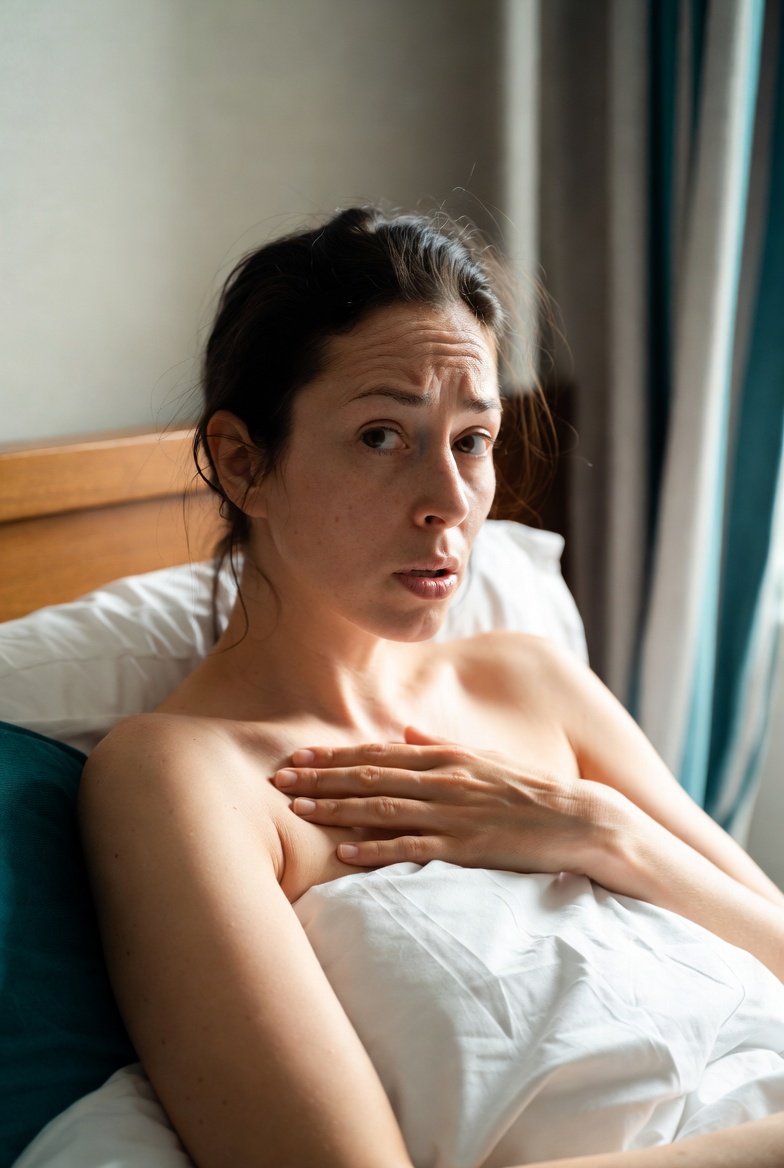
Fear of panic attacks is often more disabling than the attacks themselves. The dread of having another one, the avoidance built around preventing them, the hypervigilance that monitors the body for signs of an impending episode — these maintaining behaviours are sustained by the mystery and terror of what panic feels like. When the physiology is understood, the mystery dissolves. What remains is still uncomfortable. It is not dangerous.
You are in Tesco. You reach for a bottle of olive oil and your chest tightens. Just like that. You notice it, and in the half-second of noticing, your heart accelerates. Your fingers start tingling. You cannot get a full breath. The aisle stretches strangely, the lighting looks wrong, and a voice inside your head says with absolute certainty: something is happening. This is it.
You grip the trolley. You try to look normal. A woman in her sixties reaches past you for the balsamic. You think she must be able to tell. You think the staff must be about to come over. You think you need to get out of here before it happens in front of everyone. You feel like you are dying. You know, somehow, at the same time, that you are probably not dying — but that knowledge is not winning against the certainty of the opposite.
Here is what every cell of your body is about to tell you that is not true: you are not dying, you are not losing your mind, you will not faint, you will not stop breathing, this will not last forever. What is actually happening has a name, a mechanism, and a time limit. It peaks within about 10 minutes and fully resolves within 30, no matter what you do. Understanding the second-by-second biology of the next 20 minutes is the single most powerful thing you can know about this experience. It will not stop the attack you are having. It will change everything about the ones that follow.
Second by second: the full anatomy of a panic attack
The panic attack timeline
Amygdala fires
A trigger — external event, bodily sensation, or thought — activates the amygdala before conscious processing occurs. The amygdala does not wait for confirmation. It sends an emergency signal to the hypothalamus within milliseconds, initiating the fight-or-flight cascade.
Adrenaline flood
The hypothalamus activates the sympathetic nervous system. Adrenaline floods the bloodstream. Heart rate spikes by 20–40 beats per minute. Blood diverts from digestion to major muscle groups. Pupils dilate. The body is preparing for physical action that will not come.
Hyperventilation and CO₂ imbalance
Breathing rate increases to oxygenate the muscles prepared for action. This overshoots: too much CO₂ is expelled. The resulting imbalance constricts blood vessels, reducing blood flow to the brain. This produces: dizziness, tingling in hands and face, light-headedness, visual changes. These symptoms feel like cardiac or neurological events. They are caused by breathing.
Catastrophic interpretation
The prefrontal cortex tries to interpret the physical symptoms. It is being suppressed by the amygdala's threat signal. In its impaired state, it catastrophises: "I'm having a heart attack." "I can't breathe." "I'm going to faint." Each catastrophic interpretation re-triggers the amygdala, producing fresh adrenaline, sustaining and intensifying the cascade.
Peak and plateau
The attack reaches maximum intensity. Chest tightness, trembling, sweating, nausea, derealization, fear of dying or losing control. The body is in full fight-or-flight with nowhere to go. The adrenaline supply is finite — the body is at its peak and cannot sustain this state indefinitely.
Natural subsidence
The adrenaline supply depletes. The parasympathetic nervous system — the brake — begins to engage. Symptoms reduce. Heart rate normalises. Breathing slows. What remains is exhaustion, shakiness, and sensitisation — but the danger, which was never present, has passed.
The Panic Curve
This is the shape every panic attack follows, no matter how different they feel in the moment. The rise is fast and feels uncontrollable; the peak typically lands around the 10-minute mark; the decline is gradual but genuine. By 30 minutes the adrenaline has depleted, the parasympathetic system has engaged, and symptoms have resolved back toward baseline. Biology cannot sustain a peak panic state for hours. The body is not built for it. What can last for hours is the anticipatory anxiety about the next attack — but the acute event itself is time-limited. This is the single most therapeutic piece of information in the whole article: whatever you do or don't do during a panic attack, the curve ends. Every time. No exceptions.
Why every symptom is explicable — and not dangerous
The terror of a panic attack is sustained by the catastrophic interpretation of physical symptoms that are genuinely alarming in isolation. When you know the physiological cause of each symptom, the catastrophic interpretation loses its automaticity.
| Symptom | Physiological cause | Why it feels alarming | What it actually is |
|---|---|---|---|
| Racing heart | Adrenaline increases heart rate | Feels like cardiac event | Normal stress response — not dangerous |
| Chest tightness / pain | Muscle tension + hyperventilation | Feels like heart attack | Muscular tension — resolves within minutes |
| Difficulty breathing | Hyperventilation paradox | Feels like suffocation | Getting too much air, not too little |
| Dizziness | CO₂ drop constricts cerebral vessels | Feels like stroke or fainting | Cannot faint — panic raises blood pressure |
| Tingling / numbness | CO₂ imbalance + blood redirected | Feels like neurological event | Peripheral blood flow change — temporary |
| Nausea | Blood redirected from digestion | Feels like illness | Digestive suppression — normal in stress |
| Sweating / chills | Temperature regulation response | Feels like fever or shock | Autonomic nervous system response |
| Derealization | Perceptual filtering changes under stress | Feels like losing your mind | Protective stress response feature |
| Fear of dying | Catastrophic misinterpretation of the above | Feels certain | A thought — not a prediction |
You cannot faint during a panic attack. Fainting requires a drop in blood pressure. Panic raises blood pressure. You cannot stop breathing — your respiratory drive is hardwired and will override any conscious sensation. You cannot have a heart attack from panic — the heart is working normally, just faster. These are not reassurances. They are physiological facts.
The catastrophic misinterpretation loop
David Clark's cognitive model of panic disorder (1986) identifies the central maintaining mechanism: the catastrophic misinterpretation of bodily sensations. A normal or anxiety-produced sensation is appraised as immediately threatening ("this means I'm having a heart attack"), which produces anxiety, which produces more physical symptoms, which are appraised as confirmation of the threat. The loop is complete and self-sustaining.
Understanding this loop changes what the symptoms mean. Chest tightness during a panic attack is not evidence of a cardiac event. It is evidence that the muscles around your chest are tensed — as they are supposed to be in a stress response. The catastrophic interpretation is the dangerous part, not the sensation. The sensation is information that the stress response is active. It is the wrong interpretation of that information that sustains the attack.
This is why CBT for panic begins with psychoeducation rather than breathing techniques. Learning the accurate interpretation of symptoms — this is adrenaline, not a heart attack; this is CO₂ imbalance, not a stroke — directly undermines the catastrophic interpretation that keeps the loop running. Knowledge is not reassurance. It is genuine updating of the threat model that drives the cascade.
Why panic attacks feel worse than they are
The intense and escalating nature of panic attacks is partly a product of the loop itself and partly a product of what happens after recovery: the anticipatory anxiety of having another one. This anticipatory anxiety maintains a higher baseline arousal than someone without panic disorder, which lowers the threshold for the next attack and means each trigger produces a stronger response than it otherwise would.
It also means that many of the physical sensations that produce anxiety in someone with panic disorder are sensations that everyone experiences regularly — a brief flutter of the heart, a moment of dizziness, a twinge in the chest. In people without panic disorder, these sensations are noted and ignored. In people with panic disorder, they have been conditioned through previous attacks to be interpreted as threat signals, which triggers the catastrophic interpretation that can initiate an attack from what would otherwise be a background sensation.
This interoceptive hypersensitivity — heightened awareness and reactivity to internal bodily sensations — is a specific target in CBT for panic. Interoceptive exposure (deliberately inducing mild versions of panic sensations in a safe context) retrains the threat appraisal: these sensations are uncomfortable, familiar, and not dangerous.
What to do during a panic attack
1 Physiological sigh — immediate
Double inhale through the nose (two sharp sniffs to fully reinflate lungs), then a long complete exhale through the mouth. The double inhale reinflates the small air sacs in the lungs that collapse during hyperventilation. The extended exhale directly activates the vagus nerve, triggering parasympathetic response. This is the fastest known voluntary intervention for the physiological cascade. Two to three cycles. Do not wait until mid-attack — apply at the first physical signal.
2 Name what is happening
"This is a panic attack. I am not in danger. My body is having an adrenaline response. This will pass within 10 minutes." Say it out loud if possible. This is not reassurance — it is accurate labelling. The amygdala's threat signal is real; the threat itself is not. Naming the process accurately reduces the catastrophic interpretation that re-triggers the cascade. Research on affect labelling shows that putting language to emotional states measurably reduces amygdala activation.
3 5-4-3-2-1 grounding
Name five things you can see, four you can touch (touch them), three sounds you can hear, two things you can smell, one thing you can taste. This fills attentional bandwidth with present-moment sensory data, competing with the internal catastrophic narrative. The amygdala cannot maintain full threat-response intensity when attention is genuinely directed at non-threatening sensory experience.
4 Stay — do not flee
If you are in a situation when the attack begins, stay in it. Leaving at peak panic teaches your brain that escape was necessary — that the situation was genuinely dangerous and required flight. This reinforces avoidance and lowers the threshold for the next attack in similar situations. Staying, allowing the attack to peak and naturally subside without fleeing, teaches the opposite: this situation is survivable without escape. This is the most powerful single behaviour for long-term panic management.
Stop The Loop's emergency spiral mode guides you through panic in real time — breathing, grounding, and reframing, step by step, adapted to what you are experiencing. Not a meditation track. A live session that works with the physiology. Try it free.
See panic patterns in specific cases
- Ahmed's driving anxiety case study — the panic attack at the wheel of a motorway delivery van and the 18 months of avoidance that followed, before interoceptive exposure broke the pattern
- The 90-second rule — the technique for catching panic before it escalates, applied at the first physical sensation
- The anxiety-sleep cycle — nocturnal panic attacks, the 3am variant, and why sleep deprivation lowers the threshold
- Dr Google and health anxiety — the reassurance-seeking that often follows a first panic attack and turns a one-off into a disorder
Common mistakes during and after a panic attack
The instinctive responses to a panic attack almost always maintain or worsen panic disorder. These are the six patterns that most often turn an acute event into a chronic pattern, and what to do instead.
Fleeing the situation at peak
Leaving the supermarket, the tube carriage, the meeting room at the height of the attack feels like the only option. It also teaches your brain that the location was genuinely dangerous and that escape was necessary. This is the single largest contributor to agoraphobic spread. Staying in the situation until the attack peaks and begins to subside is the most therapeutically powerful thing you can do. If you must leave, return as soon as possible \u2014 ideally the same day.
Trying to breathe more deeply
The sensation of being unable to breathe makes you want to take bigger breaths. This accelerates hyperventilation, worsens the CO\u2082 imbalance, and intensifies the symptoms you were trying to relieve. The physiological sigh is the opposite pattern: short sharp inhales, long slow exhales. Counterintuitive, and necessary.
Calling an ambulance for repeat attacks
If it's your first unexplained chest pain, get it assessed. But once a cardiology workup has confirmed healthy heart function, calling 999 or attending A&E during subsequent attacks reinforces the belief that the attack is dangerous and teaches the nervous system that external medical confirmation is required to feel safe. This is a form of reassurance-seeking that maintains the disorder. Trust the prior assessment and work on the psychological intervention instead.
Avoiding places where attacks have happened
The supermarket, the lift, the motorway \u2014 the instinct to avoid locations of prior attacks is powerful. But avoidance is the engine of panic disorder. Each avoidance reinforces that the location is dangerous and expands the fear across related situations. The reverse behaviour (returning, deliberately, to places that produced attacks) is the core of CBT treatment. Gradual, paced, often with a partner at first, but reliable.
Dwelling on attacks afterwards
Replaying what happened, rehearsing the symptoms, worrying about when the next one will arrive. This post-mortem analysis re-activates the threat system in memory and builds anticipatory anxiety, which then lowers the threshold for the next attack. Brief factual note of trigger if identifiable, then deliberate movement to something else. The attack is over. Keep it over.
Relying on benzodiazepines for every attack
Carrying a diazepam “in case” and using it during every attack seems like a sensible safety measure. Clinically it often becomes part of the problem. The medication becomes a safety behaviour (“I can only face the tube if I have one in my pocket”), the tolerance builds, and the nervous system never learns that the attack would have ended without the medication. Short-term use under medical supervision can be appropriate; reliance as a maintenance strategy rarely is. CBT and SSRIs produce more durable recovery.
After the attack — what happens and what to do
The post-attack period is characterised by exhaustion, mild shaking, emotional vulnerability, and often significant shame or embarrassment. These are all normal consequences of the physiological event — your body has just run a full-intensity stress response for up to 30 minutes. The fatigue is real and warrants rest.
The shame is not warranted. A panic attack is a neurobiological event. It is not a character failing, an inability to cope, or evidence of weakness. It is the fight-or-flight response activating in the absence of a genuine threat. This happens to people across all demographics, all levels of capability, and all levels of psychological functioning.
What to do after an attack: rest, hydration, warmth, gentle movement when ready. Do not immediately engage in significant cognitive demands. Do not dwell on the attack in detail — detailed retelling can retrigger it. Note briefly what the trigger was (if identifiable) for future reference. Do not catastrophise about when the next one will occur — that anticipatory anxiety is itself a maintaining factor for the disorder.