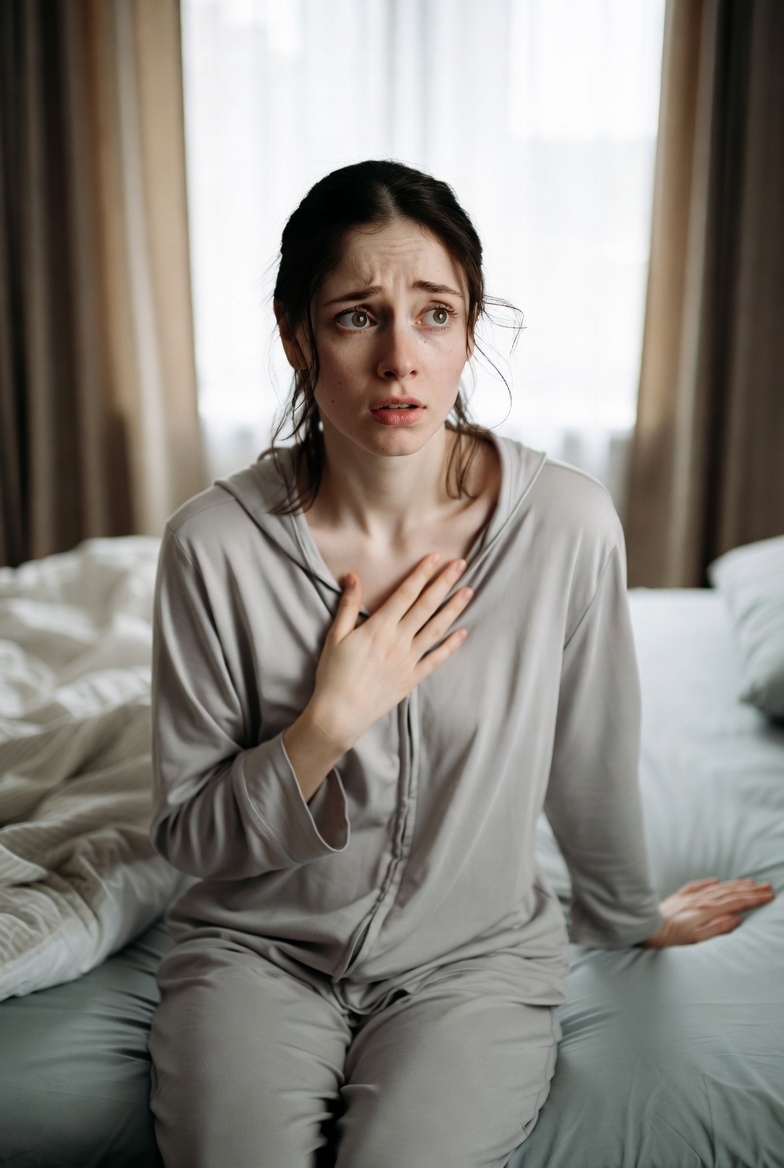
If you have ended up on this page at 2am with a hand on your chest, trying to decide whether to wake your partner or drive yourself to A&E, you are not alone and you are not overreacting for wanting to know. Chest pain is the second most common reason people attend emergency departments in the UK. A large majority of those attendances turn out to be non-cardiac. Anxiety and panic are among the most common causes. The pain is real. Your nerves are genuinely firing. But the thing you are most afraid of is also, statistically, far less likely than the thing that is almost certainly happening.
This article does two things. It walks you through the specific, useful differences that doctors look for when separating anxiety chest pain from cardiac chest pain. And it tells you the symptoms where you stop reading and call 999 immediately. Both matter. The goal is not to convince you it cannot be your heart — it is to give you better information than your panic is giving you right now.
Sources: NICE CG95; Fleet et al. (panic & non-cardiac chest pain); Goodacre et al. (UK ED chest pain cohorts).
Read this first. If chest pain right now is severe, crushing, or radiating to your jaw, left arm, back, or shoulder — if it is accompanied by cold sweat, sudden breathlessness, or nausea — if it was triggered by exertion — or if you have cardiac risk factors (high blood pressure, high cholesterol, diabetes, smoker, family history) — stop reading and call 999 now. The rest of this article can wait. A cardiac assessment cannot.
Why the overlap exists
The reason anxiety chest pain is so convincing is that the fight-or-flight response was literally designed to prepare your cardiovascular system for maximum effort. When your amygdala decides there is a threat, adrenaline floods your bloodstream within seconds. Your heart rate climbs sharply. Your coronary arteries dilate. Your breathing quickens. Blood shifts toward the large muscles. Your chest wall muscles tighten in preparation for impact. Your oesophagus can spasm. Your sensory nerves become hyper-alert.
Every single one of those changes can produce a sensation in your chest. A pounding heart feels like a cardiac event because it is a cardiac event — a completely benign one, deliberately commanded by your nervous system. Chest wall tightness feels like pressure because the muscles are genuinely tight. Rapid shallow breathing produces tingling in the hands and lips because it lowers your blood's carbon dioxide — a phenomenon called respiratory alkalosis, which is also what produces the classic panic-attack arm tingle that feels so much like the cardiac warning sign everyone has heard about.
The biology overlaps because a threat response and a cardiac event both put the heart and chest under load. The difference is that one of them is a false alarm.
The symptom overlap, in numbers
Looking at which symptoms appear in each, you can see how confusing it gets. Several of the most frightening symptoms appear in both, but their frequency and character differ. This is a rough composite from clinical literature — not a diagnostic tool, but a useful picture of the overlap.
Three patterns jump out. Tingling in the hands and face is strongly associated with anxiety and almost absent in cardiac pain — because it is a direct consequence of hyperventilation, which cardiac events do not typically produce. Radiating pain to the jaw, arm, or back is a cardinal cardiac feature and relatively rare in anxiety. And cardiac pain is almost always brought on or made worse by exertion, whereas anxiety pain most commonly appears at rest, often while sitting still, often late at night.
What doctors actually look for
When you arrive at A&E with chest pain, the clinicians assessing you are asking a specific set of questions. The answers, combined with an ECG and a blood test (troponin), settle most cases within a couple of hours. Here are the features they weight most heavily.
Central, heavy, crushing. Radiates. Triggered by exertion. Lasts and intensifies.
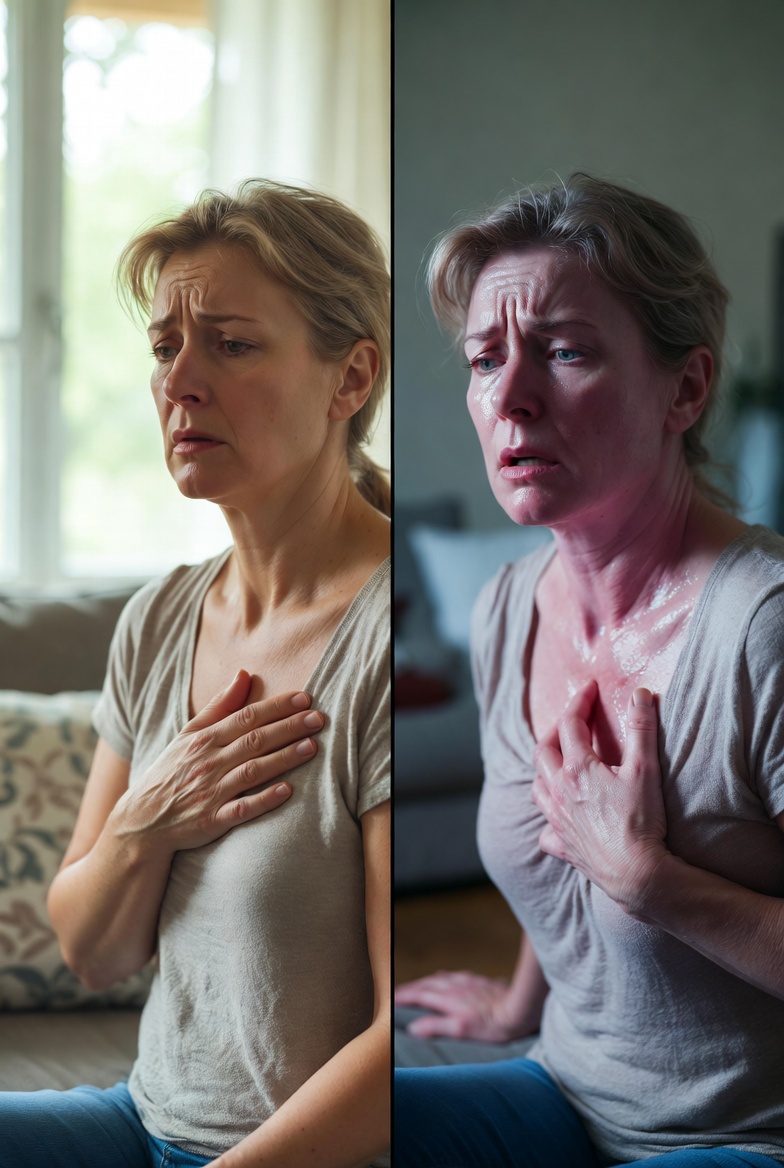
Central chest or slightly left, heavy pressure or a crushing weight, often with radiation to the jaw, left arm, back, or shoulder. Brought on by physical exertion or emotional stress. Persists for 15+ minutes without easing. Often accompanied by cold sweat, pallor, nausea, or sudden breathlessness. Does not change with position or breathing. This pattern — especially with risk factors — is a 999 call.
Sharp, local, shifting. Eases with time. Appears at rest. Tingling in hands.
Often sharp or stabbing rather than crushing, frequently localised to a small area (often left side), reproducible by pressing on the chest wall, flickering on and off in short bursts, accompanied by tingling in the hands, lips, or face, often at rest rather than on exertion, often alongside other panic symptoms (racing thoughts, derealisation, fear of dying), eases with slow breathing within 20 to 30 minutes.
No single feature settles it. A sharp, local, reproducible pain in a 28-year-old with no cardiac risk factors is overwhelmingly likely to be musculoskeletal or anxiety-driven. The same pain in a 62-year-old smoker with high cholesterol and a family history of early heart disease earns a full cardiac workup regardless of how anxiety-shaped it sounds. Risk profile matters as much as symptom pattern.
The cardiophobia loop
There is a specific, recognisable cycle that forms after a first significant anxiety chest pain episode — especially one that sent someone to A&E. Clinicians call it cardiophobia, and it is one of the most common forms of health anxiety. It works like this.
The cardiophobia loop
How a single episode of chest pain can install a long-running cycle
What makes this loop so sticky is that every element of it feels rational in the moment. Checking your pulse feels responsible. Going to A&E feels safe. Googling symptoms feels informed. Avoiding exercise feels cautious. Each of these behaviours gives short-term relief — and each one tells your brain that cardiac catastrophe is a real threat that requires constant monitoring. The next chest flicker gets louder, not quieter. And the cycle deepens.
Breaking it does not mean ignoring your heart. It means, once you have been clinically assessed and cleared, gradually trusting the assessment rather than repeatedly redoing it. That is uncomfortable. It is also the only thing that actually works.
Something you can do right now
If you are still feeling wired, if the chest tightness has not fully cleared, or if you are reading this trying to ride out a wave of anxiety — here is a breathing exercise that genuinely works. Box breathing: four seconds in, hold for four, four out, hold for four. Used in clinical panic protocols, by the Royal Marines, and by paramedics. It mechanically slows your breathing, which raises blood CO2 back to normal, which switches your nervous system out of the fight-or-flight state. Chest wall tension eases. Tingling fades. The heart slows.
Tap start. Follow the circle. Two or three minutes is enough.
Box breathing pacer
Follow the circle. Breathe in as it grows. Hold. Breathe out as it shrinks. Hold.
If the chest tightness is anxiety-driven, it will ease within two to three minutes of slow breathing. If it does not — or if it worsens — that itself is useful information. Get assessed.
The symptoms where you stop guessing
There are chest pain features that, individually or in combination, warrant emergency assessment regardless of how likely anxiety is. The point is not to make you call 999 for every flicker. It is to make sure you recognise the patterns that need a paramedic, not a breathing exercise.
Call 999 immediately if: the pain is severe, crushing, or heavy; it radiates to the jaw, left arm, back, or shoulder; it was triggered or worsened by physical exertion; you have cold sweat, sudden breathlessness, or nausea that feels unlike your usual panic; the pain lasts longer than 15 to 20 minutes without easing; you collapsed or lost consciousness; you have cardiac risk factors (high blood pressure, high cholesterol, diabetes, smoker, strong family history) and this feels unfamiliar; it is your first significant chest pain episode and you have doubt. Paramedics and A&E assess chest pain constantly — they would far rather check a panic attack than miss a cardiac event.
Once you have been cleared
If you have already had an ECG, a troponin blood test, a clinical examination, and the verdict was "this is not cardiac" — the next step is not more cardiac tests. It is addressing the anxiety that is driving the sensations and the hypervigilance. This is the step most people skip, which is why so many end up back in A&E a month later with the same symptoms and the same normal results.
After a clear cardiac workup, repeated scans, private echocardiograms, and frantic Google searches will not make the chest sensations go away. They will, over time, make them louder. Every reassurance-seeking behaviour is a little brick in the wall of cardiophobia.
What actually helps: trusting the assessment you have already had. Breathing exercises when sensations spike. Gradually returning to exercise (which improves both cardiac and anxiety outcomes). CBT for health anxiety — one of the most evidence-backed interventions in psychology for exactly this pattern. Not another scan.
What to do in the next 48 hours
- If the pain is still present and fits a cardiac pattern, stop reading and call 999. No amount of reassurance from this page replaces an ECG.
- If the pain has settled and this is a recurring anxiety-pattern, book a GP appointment this week. Not to demand a scan, but to discuss the pattern, check risk factors, and get referred to NHS Talking Therapies if appropriate.
- Cut caffeine for a week. Caffeine directly amplifies both chest awareness and adrenaline — it is often the hidden driver of "random" chest episodes.
- Cut alcohol for a week. Hangxiety the morning after drinking is a well-known driver of chest pain episodes, particularly in the 24–48 hours after heavy drinking.
- Return to gentle exercise. Avoiding exercise because of chest sensations is one of the single fastest ways to entrench cardiophobia. Unless you have been told otherwise by a clinician, move.
- Stop checking your pulse. This is harder than it sounds. Each check is a small reinforcement of the belief that your heart is the problem. Break the habit.
- If it happens again, use the breathing exercise above. Do not add "going to A&E again" to an already-investigated, cleared symptom unless something has genuinely changed.
A last word
The thing nobody tells you when you walk out of A&E with a normal ECG is that the relief lasts about 48 hours. Then the next flicker arrives and the whole question reopens. This is not you being irrational. This is a specific, well-described, treatable anxiety pattern that forms in the exact way yours has formed, to many thousands of people every year.
The way out is not more cardiac tests. It is, gradually, believing the ones you have already had — and learning to respond to chest sensations the way the evidence says they deserve to be responded to: with curiosity rather than panic, with breathing rather than Googling, with movement rather than avoidance. It is uncomfortable. It is also, demonstrably, the thing that actually quiets the sensations over time.
Your heart is almost certainly fine. Your nervous system is doing something very human, very understandable, and very fixable. The chest pain is real. The interpretation is the part that can change.