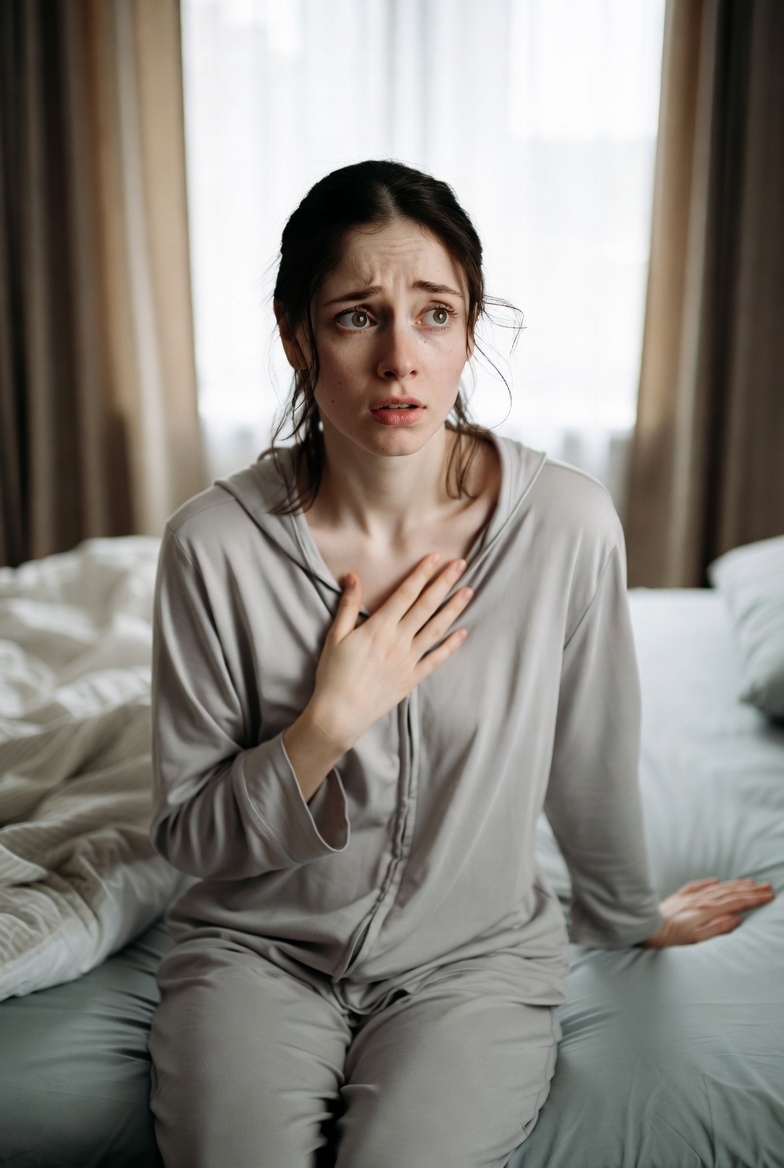
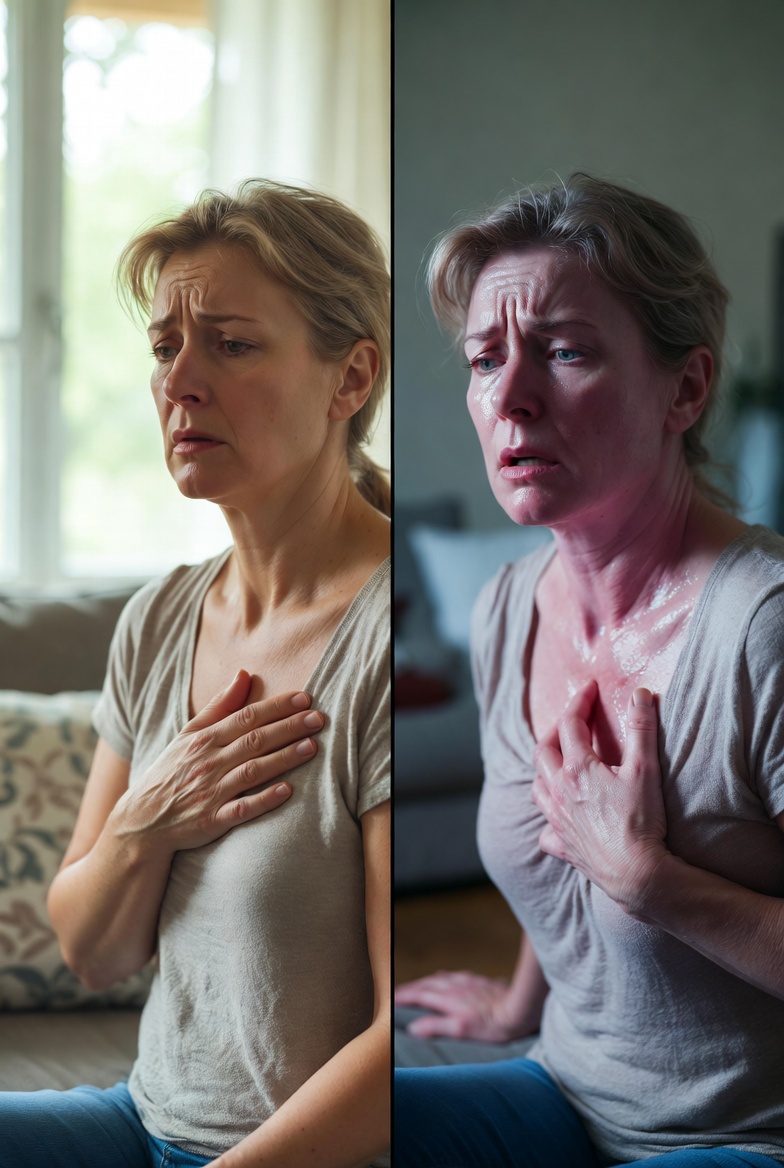
If you have ever been mid-panic-attack with someone kindly telling you to "take a deep breath" while your chest tightened and your hands tingled and you felt like you were suffocating anyway — there is a reason for that. It is not that the advice is unhelpful because you are too far gone. It is that the advice is, for acute hyperventilation, physiologically backwards. Deep breaths do not fix the problem. They extend it.
This is not a controversial claim. It has been known in respiratory physiology for more than fifty years. It just has not reached the general public, which is why "just breathe" remains the most common and least effective piece of advice given to a panicking person. This article fixes that.

Sources: Ley (panic & hyperventilation); Meuret & Ritz (respiratory training in panic); cerebral blood flow studies in acute hypocapnia.
What is actually happening
Under normal conditions, your breathing balances two things: bringing oxygen in and releasing carbon dioxide out. You rarely think about CO2, but it is the quiet variable that controls almost everything. It sets your blood's pH. It tells your blood vessels how wide to be. It regulates how tightly oxygen binds to haemoglobin. It is, in practical terms, the thermostat of your respiratory system.
When you breathe too fast or too deep — which is exactly what a panic attack triggers — you blow off CO2 faster than your body is making it. Your blood CO2 level drops sharply. Within 30 to 60 seconds, it can fall by 25 percent or more. This change is what produces the symptoms that feel so much like suffocating.
The hyperventilation cascade
Why over-breathing creates the exact sensations that make you breathe more
The cruel part is the last step. The low CO2 makes the brain feel oxygen-starved — even though your blood oxygen is actually normal or slightly elevated. Your body responds to the feeling by breathing more, which drops CO2 further, which deepens the symptoms. You are trapped in a loop where the thing that feels like the solution is the thing driving the problem.
The symptoms that are actually low CO2
Almost every "scary" sensation of a panic attack has a direct explanation in hypocapnia — the medical term for low blood CO2. Knowing this breaks the catastrophic interpretation that fuels the attack.
Every one of these has a completely benign physiological explanation. Tingling is nerves firing more easily in low-CO2 blood. Chest tightness is over-worked respiratory muscles and a stiffened diaphragm. The feeling of suffocation is your brain misreading low CO2 as if it were low oxygen. Unreality and fog are reduced cerebral blood flow. None of it is dangerous. All of it reverses the moment you breathe less.
Why "just breathe" makes it worse
When someone says "take a deep breath," the image in their head is a calm yoga inhale — and when calm, that advice is fine. In panic, it lands differently. You interpret "deep" as "big", gulp a large volume of air, and then exhale it quickly to gulp another one. Each of those big breaths pushes more CO2 out. The attack deepens.
"Take a deep breath. Breathe into a paper bag. Try to fill your lungs."
Big, deep, fast inhalations continue to push CO2 out of your blood. Paper bags can be dangerous if the cause is not hyperventilation. Focusing on inhalation without extending the exhale does nothing to rebuild CO2. "Filling your lungs" is the opposite of what helps.
Small, slow, longer out than in. Belly, not chest. Five or six breaths per minute.
Smaller breaths reduce CO2 loss. Longer exhales allow CO2 to rebuild. Belly breathing bypasses the tight, over-worked chest muscles. Around 5 to 6 breaths per minute is the rate the research consistently shows normalises CO2 fastest and calms the nervous system in parallel.
The 90-second reset
This is the technique that works. It is an extended-exhale pattern: roughly 4 seconds in, a brief pause, and 6 seconds out, repeated. The maths is deliberate — the longer exhale gives your body time to retain CO2, which reverses the cascade.
Start the pacer below. Breathe in as the circle grows, out as it shrinks. Small, gentle, nasal if possible. Do not try to fill your lungs. If you do it properly, the tingling will begin to ease within 45 seconds, and the acute phase will be over inside 2 to 3 minutes.
Extended-exhale pacer
Small breath in as the circle grows. Slow, longer breath out as it shrinks. Pause. Repeat.
If the first 30 seconds feel like "this isn't working", that is normal. CO2 takes roughly a minute to rebuild. Stay with it past the urge to give up. That urge is the loop trying to keep itself alive.
What if the pacer is too slow?
In acute hyperventilation, the 4-in, 6-out pattern can genuinely feel unbearable at first. Your brain is demanding air. You feel like you are drowning. This is the loop talking. Three adjustments that help without abandoning the technique:
- Exhale through pursed lips. Like blowing out a candle, slowly. This extends the exhale without requiring more effort on your part.
- Cup your hands over your nose and mouth. For 30 to 60 seconds only. You re-inhale a small amount of your own CO2, which raises blood CO2 faster than paced breathing alone. Stop as soon as the tingling fades.
- Breathe with your belly, not your chest. Put one hand on your stomach. As you inhale, the hand should rise. If only your chest is moving, you are using the over-worked accessory muscles that are making the tightness worse.
When it is not hyperventilation
Everything above assumes the breathing distress is anxiety-driven. That is the most common cause by far — but it is not the only one. If the breathing problem does not match the pattern of panic hyperventilation, the paced-breathing reset is not the answer.
Call 999 or seek urgent help if: the breathlessness came on suddenly and is not easing; you have chest pain that feels heavy or crushing, or that radiates to the jaw, arm, or back; you have blue-tinged lips or fingertips; you have known asthma and your inhaler is not working; you have leg pain or swelling alongside sudden breathlessness (possible blood clot); you collapsed or feel about to; or the paced breathing is making symptoms worse rather than better. Hyperventilation is a safe assumption only once medical causes have been considered.
The longer-term fix
Acute episodes respond to the pacer. Chronic hyperventilation — breathing slightly too much for weeks or months, often without realising — is a separate problem and needs a different approach. It is a surprisingly common and under-recognised cause of symptoms that get mislabelled as "mystery fatigue", "anxiety", or "something wrong with my heart or lungs". If you find yourself sighing frequently, feeling breathless at rest, or noticing the same tingling/fog/tightness on and off through the day, you may be chronically over-breathing.
The treatment in both cases is the same underlying skill: learning to breathe less, slower, lower in the body. Techniques like capnometry-guided breathing training (measuring CO2 directly), Buteyko-style practice, and daily paced-breathing drills all work by the same mechanism. Ten minutes a day for a few weeks retrains the baseline. The gains carry over into real attacks, where the reset becomes automatic because the body now remembers what "right" feels like.
The one thing to take away: when panic breathing kicks in, your job is not to get more air. It is to get less — slower, smaller, longer out. Everything else follows from that one correction.
A last word
The next time you feel the tingling start in your hands and the chest tighten and the room starts to go slightly unreal — remember what is happening. You are not suffocating. You are breathing too much. Your blood oxygen is fine. The part that feels wrong is your CO2, and you can bring it back up in 90 seconds by doing less, not more. Small breaths. Long exhales. Belly, not chest. You are in control of the thermostat. You just need to turn it the right way.